
- The Enemy Sowed While Men Slept: How False Seed Enters the Field When Watchfulness Dies
- Another Gospel: When Good News Stops Calling Men to Repent
- Another Spirit: Testing the Fire Before You Call It Holy
- Another Jesus: The Messiah the Flesh Can Tolerate
- Lord, Lord, But Lawlessness: How Religious Activity Can Hide a Rebellious Heart
- Strange Fire Beside the Altar: How Mixture Turns Worship Into Contamination
- The Fruit Tells on the Root: How the Seed Eventually Reveals Itself Through Fruit
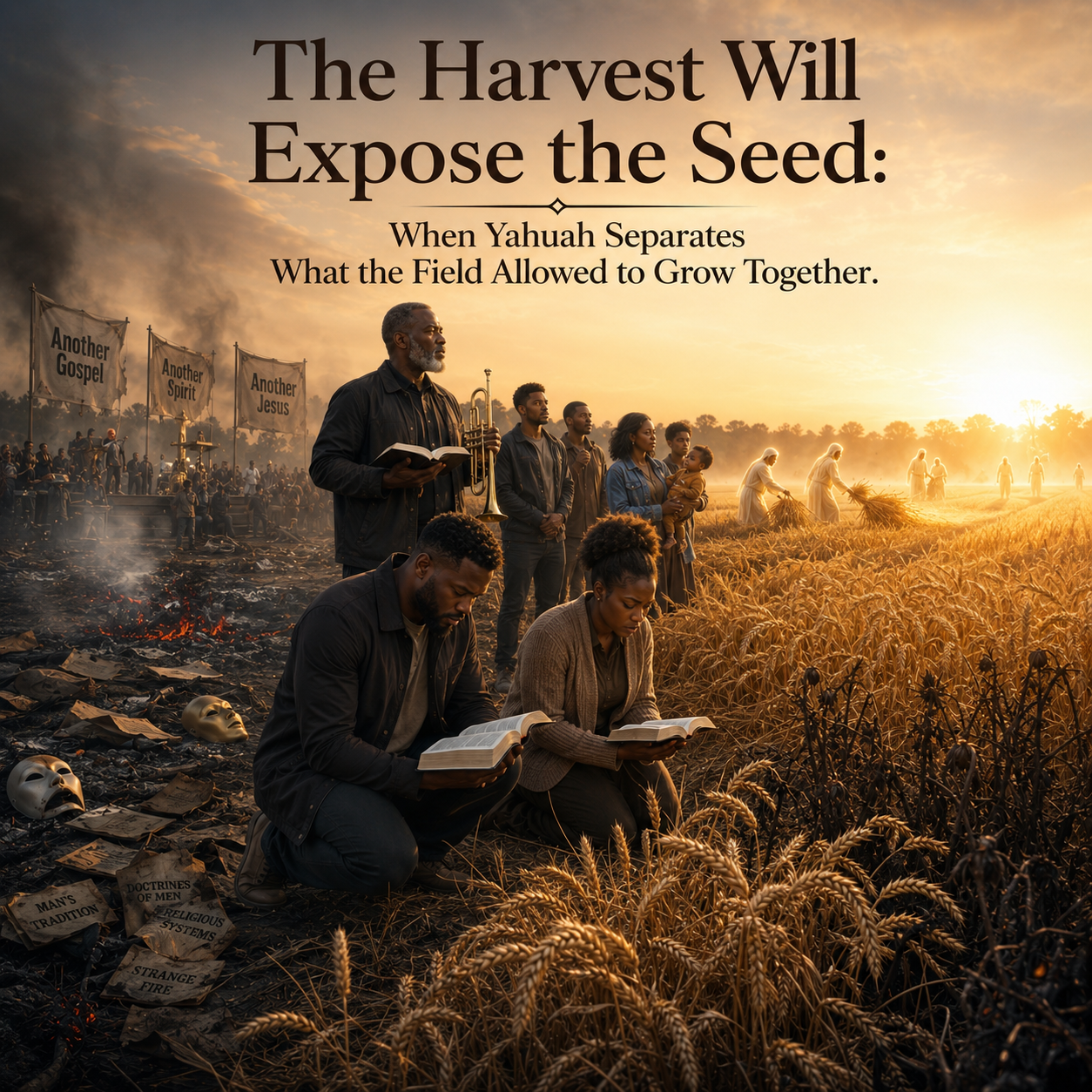
- The Harvest Will Expose the Seed: When Yahuah Separates What the Field Allowed to Grow Together
Shalom mishpacha. We have now come to Part 8 of this series, and this is where the whole matter comes to its appointed end.
We began in the field, where Yahusha said the enemy sowed tares while men slept. Then we followed the false seed as it produced another gospel, another spirit, another Jesus, strange fire, lawless religion, and fruit that eventually tells on the root. Now we come to the harvest.
And the harvest is not a suggestion.
The harvest is not symbolic language for something light.
The harvest is the appointed moment when Yahuah separates what was allowed to grow together for a season.
That is the part we have to sit with.
For a season, wheat and tares may stand in the same field.
For a season, false worship may grow beside truth.
For a season, another gospel may use the language of the true Besorah.
For a season, another spirit may move in religious spaces and be called holy.
For a season, another Jesus may be preached while people still say, “Lord, Lord.”
For a season, strange fire may burn beside the altar.
For a season, lawlessness may hide behind religious activity.
For a season, fruit may still be immature enough for people to confuse the seed.
But the season does not last forever.
The harvest comes.
And when the harvest comes, the field stops hiding what the seed really was.
Mattithyahu (Matthew) 13:37–39 says Yahusha answered and said, “He that soweth the good seed is the Son of man; the field is the world; the good seed are the children of the kingdom; but the tares are the children of the wicked one; the enemy that sowed them is the devil; the harvest is the end of the age; and the reapers are the messengers.”
Beside this, we place Qoheleth (Ecclesiastes) 12:14, where Scripture says Elohim shall bring every work into judgment, with every secret thing, whether good or evil.
Beside this, we place Ibrim (Hebrews) 4:12–13, where the Word of Elohim discerns the thoughts and intents of the heart, and all things are naked and opened before Him.
Beside this, we place Dani’el (Daniel) 12:2–3, where many who sleep in the dust awake, some to everlasting life and some to shame and everlasting contempt.
So Yahusha explains the parable plainly.
The harvest is the end of the age.
The reapers are the messengers.
The good seed are the children of the Kingdom.
The tares are the children of the wicked one.
That means the harvest is not merely about religious labels. It is about revealed identity.
Not who had the strongest claim.
Not who had the best image.
Not who had the loudest confession.
Not who had the biggest gathering.
Not who had the most convincing appearance.
Seed.
The harvest exposes seed.
And that is why this final study must be handled with fear and humility. This is not permission for us to become arrogant. This is not permission for people to run through the field with suspicion, trying to play reaper before the appointed time. Yahusha already warned against that. The servants wanted to pull up the tares early, but the Master said to let both grow together until the harvest.
Mattithyahu (Matthew) 13:28–30 says the servants asked if they should gather up the tares, but the Master said no, lest while gathering the tares they also root up the wheat with them. He said to let both grow together until the harvest.
Beside this, we place Qorintiyim Aleph (1 Corinthians) 4:5, which says not to judge before the time, until Yahuah brings to light the hidden things of darkness and makes manifest the counsels of the hearts.
Beside this, we place Romiyim (Romans) 14:10–12, where each of us shall stand before the judgment seat of Messiah and give account of himself to Elohim.
Beside this, we place Ya’aqob (James) 4:11–12, where Scripture reminds us there is one Lawgiver and Judge who is able to save and destroy.
So let us get the balance right.
We are commanded to discern fruit.
We are commanded to test spirits.
We are commanded to reject another gospel.
We are commanded to come out of mixture.
We are commanded to warn.
But we are not the final reapers.
We do not own the field.
We do not see every root.
We do not know every secret counsel of the heart.
We do not separate the final harvest by our own hand.
Yahuah does.
That keeps discernment from becoming pride.
That keeps warning from becoming cruelty.
That keeps truth from becoming a weapon for the flesh.
The wheat does not need to become arrogant about being wheat. The wheat bows because it belongs to the Master. The wheat bears grain because Yahuah planted good seed. The wheat trembles because the harvest belongs to Him.
That is the posture we need.
Sober, not proud.
Awake, not reckless.
Discerning, not destructive.
Courageous, not cruel.
Because the harvest is real, and Yahuah is not mocked.
Galatiyim (Galatians) 6:7–8 says, “Be not deceived; Elohim is not mocked: for whatsoever a man soweth, that shall he also reap. For he that soweth to his flesh shall of the flesh reap corruption; but he that soweth to the Ruach shall of the Ruach reap life everlasting.”
Beside this, we place Hoshea (Hosea) 10:12, where Yahuah says to sow in righteousness and reap in mercy.
Beside this, we place Mishlei (Proverbs) 22:8, where the one who sows iniquity shall reap vanity.
Beside this, we place Ya’aqob (James) 3:18, where the fruit of righteousness is sown in peace by those who make peace.
Seed becomes harvest.
That is the spiritual law running under this whole series.
Another gospel is seed.
Another spirit is seed.
Another Jesus is seed.
Strange fire is seed.
Lawlessness is seed.
Pride is seed.
Bitterness is seed.
Truth is seed.
Repentance is seed.
Obedience is seed.
Mercy is seed.
Faithfulness is seed.
What we water grows, and what grows will be harvested.
That is why the harvest is not random. It is revelation. It reveals what was being sown all along.
Some people want the harvest to ignore the seed. They want to sow to the flesh and reap from the Ruach. They want to sow lawlessness and reap inheritance. They want to sow mixture and reap clean worship. They want to sow pride and reap glory. They want to sow another gospel and reap Kingdom fruit.
But Scripture says Yahuah is not mocked.
The harvest will not be bribed by religious speech.
The harvest will not be fooled by titles.
The harvest will not be impressed by platforms.
The harvest will not confuse leaves for fruit.
The harvest will not gather tares into the barn just because they grew beside wheat.
That is the terror of the harvest.
But it is also the comfort of the harvest.
Because the same harvest that exposes false seed also vindicates true seed.
There are wheat people who have been misunderstood. There are obedient servants who have been mocked. There are quiet ones who have been overlooked because they did not perform. There are faithful ones who kept the Word when it cost them. There are households that came out of mixture and were called extreme. There are watchmen who blew the trumpet and were called negative. There are people who trembled at the Word while the crowd chased strange fire.
The harvest will reveal them too.
Mal’akhi (Malachi) 3:16–18 says those who feared Yahuah spoke often one to another, and Yahuah listened and heard, and a book of remembrance was written before Him for those who feared Yahuah and thought upon His name. Then He says they shall be His in the day He makes up His jewels, and people shall return and discern between the righteous and the wicked, between the one who serves Elohim and the one who serves Him not.
Beside this, we place Tehillim (Psalm) 1:1–6, where the righteous are like a tree planted by rivers of water bringing fruit in season, while the wicked are like chaff driven away by the wind.
Beside this, we place Yirmeyahu (Jeremiah) 17:7–8, where the one who trusts in Yahuah is like a tree planted by waters, whose leaf stays green and does not cease from yielding fruit.
Beside this, we place Mattithyahu (Matthew) 25:34, where the King says to those on His right hand, “Come, ye blessed of my Father, inherit the kingdom prepared for you.”
The harvest exposes, but it also gathers.
It burns, but it also barns.
It separates, but it also secures.
It judges false seed, but it also brings wheat into the Master’s care.
So for those who belong to Yahuah, the harvest is not only a warning. It is hope.
Because Yahuah sees what men missed.
He sees the prayers nobody heard.
He sees the obedience nobody applauded.
He sees the tears shed in repentance.
He sees the quiet faithfulness.
He sees the cost of coming out.
He sees the ones who chose truth over comfort.
He sees the ones who followed Yahusha when the broad road looked easier.
He sees the ones who trembled at His Word when others mocked correction.
The harvest will tell the truth.
And that should comfort the faithful and sober the careless.
Mattithyahu (Matthew) 13:40–43 says as the tares are gathered and burned in the fire, so shall it be at the end of the age. The Son of man shall send forth His messengers, and they shall gather out of His Kingdom all things that offend and those who do lawlessness, and cast them into a furnace of fire. Then the righteous shall shine forth as the sun in the Kingdom of their Father. “Who hath ears to hear, let him hear.”
Beside this, we place Tsephanyah (Zephaniah) 1:14–18, where the day of Yahuah is described as near and bitter, a day of wrath, trouble, distress, wasteness, darkness, and alarm.
Beside this, we place Mattithyahu (Matthew) 25:31–46, where the Son of man sits on the throne of His glory and separates as a shepherd divides sheep from goats.
Beside this, we place Chazon (Revelation) 22:12–14, where Yahusha says He comes quickly and His reward is with Him, to give every man according to his work, and blessed are those who do His commandments that they may have right to the tree of life.
Yahusha says the reapers gather out of His Kingdom all things that offend and those who do lawlessness.
That phrase connects directly to Part 6.
Lawlessness will not survive the harvest.
It may survive religious systems.
It may survive public image.
It may survive emotional worship.
It may survive smooth preaching.
It may survive “Lord, Lord” language.
But it will not survive the harvest.
Because the harvest does not judge by what lawlessness called itself. It judges by what lawlessness was.
And notice again: Yahusha does not say the tares lacked religion. The whole series has shown us the danger of false religion. Another gospel can be religious. Another spirit can be religious. Another Jesus can be religious. Strange fire can be religious. Lawlessness can be religious.
But the harvest exposes religious rebellion.
That is why Yahusha says, “Who hath ears to hear, let him hear.”
Not everybody will hear this. Some will defend the field as it is. Some will say the warning is too sharp. Some will call discernment hatred. Some will call repentance legalism. Some will call obedience bondage. Some will call coming out unnecessary. Some will call strange fire acceptable because it feels familiar.
But those with ears must hear.
The harvest is coming.
And before the harvest, mercy is calling.
That is the heart we cannot miss. Yahuah warns before He separates. He exposes before He judges. He sends the Word before the sickle. He sends correction before the fire. He sends conviction before the final sentence.
Kepha Sheniy (2 Peter) 3:9 says Yahuah is not slack concerning His promise, but is longsuffering toward us, not willing that any should perish, but that all should come to repentance.
Beside this, we place Yechezqel (Ezekiel) 33:11, where Yahuah says He has no pleasure in the death of the wicked, but that the wicked turn from his way and live.
Beside this, we place Ma’aseh (Acts) 17:30–31, where Elohim commands all men everywhere to repent because He has appointed a day in which He will judge the world in righteousness by the Man He ordained.
Beside this, we place Chazon (Revelation) 3:19, where Yahusha says, “As many as I love, I rebuke and chasten: be zealous therefore, and repent.”
Judgment is appointed.
Repentance is commanded.
Mercy is available.
That is the message.
Yahuah is not warning us because He delights in destruction. He is warning because He is merciful. He is calling people out before Babylon falls. He is calling people out before the tares are gathered. He is calling people out before the fire tests every work. He is calling people out before religious appearance is stripped away.
So do not despise conviction.
Do not waste the warning.
Do not defend what the Word is exposing.
Do not call the pruning knife cruel when it is cutting away what would destroy you.
Do not wait for the harvest to reveal what repentance could have dealt with now.
This is why Chazon gives the call: come out.
Chazon (Revelation) 18:4 says, “Come out of her, my people, that ye be not partakers of her sins, and that ye receive not of her plagues.”
Beside this, we place Yirmeyahu (Jeremiah) 51:6, “Flee out of the midst of Babylon, and deliver every man his soul.”
Beside this, we place Yesha’yahu (Isaiah) 52:11, “Depart ye, depart ye, go ye out from thence, touch no unclean thing.”
Beside this, we place Qorintiyim Sheniy (2 Corinthians) 6:17–18, where Scripture says, “Come out from among them, and be ye separate,” and Yahuah will receive His people.
Come out before judgment falls.
Come out before the cup is finished.
Come out before the harvest exposes the seed you kept defending.
Come out of another gospel.
Come out of another spirit.
Come out of another Jesus.
Come out of strange fire.
Come out of lawlessness.
Come out of mixture.
Come out of performance.
Come out of Babylon’s cup.
Come out of anything that lets you claim covenant while practicing rebellion.
Because coming out is not only about leaving a building. It is about leaving agreement.
You can leave a system and still carry its seed.
You can reject one doctrine and still carry the pride that doctrine fed.
You can stop attending one place and still worship the same flesh in another form.
You can use restored names and still have an uncircumcised heart.
You can expose Babylon and still defend Babylonian attitudes.
You can know the truth about tares and still water tare-seed in yourself.
That is why the harvest warning must search us before it becomes content for others.
Tehillim (Psalm) 139:23–24 says, “Search me, O El, and know my heart: try me, and know my thoughts: and see if there be any wicked way in me, and lead me in the way everlasting.”
Beside this, we place Qorintiyim Sheniy (2 Corinthians) 13:5, where we are told to examine ourselves, whether we are in the faith.
Beside this, we place Ibrim (Hebrews) 12:15, where we are warned about a root of bitterness springing up and defiling many.
Beside this, we place Ya’aqob (James) 4:8–10, where sinners are told to cleanse their hands, purify their hearts, be afflicted, mourn, weep, and humble themselves before Yahuah.
This is wheat language.
Search me.
Try me.
Cleanse me.
Lead me.
A tare does not want to be searched. A tare wants to stay hidden in the field.
A tare does not want pruning. A tare wants appearance.
A tare does not want repentance. A tare wants defense.
A tare does not want the Word to cut. A tare wants the Word to be edited.
But wheat can pray, “Search me,” because wheat trusts the hand of the Master.
And this brings us to one of the most important parts of the harvest: the Word itself exposes.
Before the final harvest, the Word already comes as a discerner.
Ibrim (Hebrews) 4:12 says the Word of Elohim is living and powerful, sharper than any two-edged sword, piercing even to the dividing apart of soul and spirit, joints and marrow, and is a discerner of the thoughts and intents of the heart.
Beside this, we place Yochanan (John) 12:48, where Yahusha says the word He has spoken will judge in the last day.
Beside this, we place Yochanan (John) 17:17, where Yahusha says, “Sanctify them through thy truth: thy word is truth.”
Beside this, we place Tehillim (Psalm) 119:9–11, where the way is cleansed by taking heed according to Yahuah’s Word and hiding His Word in the heart.
The Word cuts now so the harvest does not expose us later as false.
The Word discerns now.
The Word sanctifies now.
The Word cleanses now.
The Word reveals the thoughts and intents now.
That is mercy.
So when Scripture confronts our tradition, that is mercy.
When Scripture confronts our appetite, that is mercy.
When Scripture confronts our pride, that is mercy.
When Scripture confronts our worship, that is mercy.
When Scripture confronts our image of Messiah, that is mercy.
When Scripture confronts our lawlessness, that is mercy.
The cutting Word is not the enemy.
The flattering lie is the enemy.
The Word wounds to heal.
The lie comforts to destroy.
That is why another gospel is so dangerous: it removes the wound that leads to healing. Another spirit removes conviction and replaces it with atmosphere. Another Jesus gives people a Messiah who does not confront them. Strange fire gives them worship that does not require surrender. Lawless religion gives them confidence without obedience. False fruit gives them appearance without grain.
But the harvest strips all of that away.
Qorintiyim Aleph (1 Corinthians) 3:11–15 says no foundation can be laid except Yahusha Messiah, and every man’s work will be revealed by fire. The fire will test what sort of work it is. If the work remains, there is reward. If the work burns, there is loss.
Beside this, we place Mal’akhi (Malachi) 3:2–3, where Yahuah is like a refiner’s fire and purifier of silver.
Beside this, we place Ibrim (Hebrews) 12:28–29, where we are told to serve Elohim acceptably with reverence and fear, for our Elohim is a consuming fire.
Beside this, we place Kepha Aleph (1 Peter) 1:7, where the trial of faith is more precious than gold tested by fire.
Fire reveals what kind of work it is.
Not how impressive it looked.
Not how many people praised it.
Not how much emotion surrounded it.
What kind.
Wood, hay, and stubble may look like volume, but fire exposes substance.
Gold, silver, and precious stones may not look as large, but they endure.
That is a word for this generation.
Do not build big if it cannot survive fire.
Do not build loud if it cannot survive truth.
Do not build fast if it is not built on Yahusha.
Do not build public if your private foundation is sand.
Do not build a ministry around a gift while neglecting fruit.
Do not build a doctrine around comfort while ignoring repentance.
Do not build an identity around awakening while refusing humility.
The fire will test what kind.
And the harvest will expose what seed.
This is also why Yahusha’s parable of the wise and foolish builders matters here.
Mattithyahu (Matthew) 7:24–27 says whoever hears His sayings and does them is like a wise man who built on rock. Whoever hears and does not do them is like a foolish man who built on sand. The rain descends, floods come, winds blow, and the house on sand falls greatly.
Beside this, we place Ya’aqob (James) 1:22, where we are told to be doers of the Word and not hearers only, deceiving ourselves.
Beside this, we place Luqas (Luke) 11:28, where Yahusha says blessed are those who hear the Word of Elohim and guard it.
Beside this, we place Romiyim (Romans) 2:13, where the hearers of the Torah are not just before Elohim, but the doers.
The storm exposes foundation.
The fire exposes work.
The fruit exposes root.
The harvest exposes seed.
Do you see the pattern?
Yahuah has many witnesses, and they all tell the same truth.
What is hidden will be revealed.
Luqas (Luke) 12:2–3 says there is nothing covered that shall not be revealed, neither hid that shall not be known.
Beside this, we place Marqus (Mark) 4:22, where nothing is hid that shall not be manifested.
Beside this, we place Timotheos Aleph (1 Timothy) 5:24–25, where some sins are open beforehand, going before to judgment, and some follow after; likewise good works are manifest, and those otherwise cannot be hidden.
Beside this, we place Ibrim (Hebrews) 4:13, where all things are naked and opened before the eyes of Him with whom we have to do.
The hidden thing has an appointment.
Secret obedience has an appointment.
Secret wickedness has an appointment.
Hidden repentance has an appointment.
Hidden pride has an appointment.
Hidden mercy has an appointment.
Hidden lawlessness has an appointment.
Everything is moving toward revelation.
That is why the wise do not live for appearance. Appearance is temporary. Revelation is coming.
The wise live before Yahuah.
The wise let the Word search them.
The wise confess and forsake sin.
The wise tremble at the warning.
The wise build on rock.
The wise fill their lamps.
The wise bear fruit.
This is where the parable of the ten virgins also speaks to the harvest theme.
Mattithyahu (Matthew) 25:1–13 shows ten virgins who all had lamps, but five were wise and five were foolish. The foolish had lamps but no oil ready, and when the bridegroom came, the door was shut.
Beside this, we place Mattithyahu (Matthew) 24:42–44, where Yahusha says to watch because we do not know the hour.
Beside this, we place Luqas (Luke) 21:34–36, where Yahusha warns that hearts can be weighed down and says to watch and pray always.
Beside this, we place Chazon (Revelation) 16:15, where Yahusha says He comes as a thief, and blessed is the one who watches and keeps his garments.
All ten had lamps.
That is another sobering picture.
All had the appearance of readiness.
All went out to meet the bridegroom.
All were in the same outward category.
But when the moment came, the difference was revealed.
The harvest exposes seed.
The coming exposes readiness.
The storm exposes foundation.
The fire exposes work.
The fruit exposes root.
We need oil, not just lamps.
We need obedience, not just language.
We need fruit, not just leaves.
We need Yahusha of Scripture, not another Jesus.
We need the Ruach of truth, not another spirit.
We need the true Besorah, not another gospel.
We need clean worship, not strange fire.
We need the narrow path, not religious camouflage.
Because when the door shuts, explanation will not replace preparation.
That sounds hard, but it is mercy to say it now.
There is still time to repent.
There is still time to come out.
There is still time to let Yahuah cleanse the altar.
There is still time to reject the counterfeit.
There is still time to bear fruit worthy of repentance.
There is still time to stop watering false seed.
There is still time to ask for a clean heart.
There is still time to return to the Shepherd’s voice.
But time is not something to play with.
Yesha’yahu (Isaiah) 55:6–7 says, “Seek ye Yahuah while he may be found, call ye upon him while he is near: let the wicked forsake his way, and the unrighteous man his thoughts: and let him return unto Yahuah, and he will have mercy upon him.”
Beside this, we place Ibrim (Hebrews) 3:15, “Today if ye will hear his voice, harden not your hearts.”
Beside this, we place Qorintiyim Sheniy (2 Corinthians) 6:2, “Behold, now is the accepted time; behold, now is the day of salvation.”
Beside this, we place Mishlei (Proverbs) 28:13, where the one who confesses and forsakes sin receives mercy.
Now is mercy time.
Not later.
Not when the harvest is already separating.
Not when the fire is already testing.
Not when the door is already shut.
Now.
This is why the series has been so direct. Not to entertain. Not to accuse. Not to build fear without hope. But to call the people of Yahuah back before the harvest.
Because false worship grows beside truth until the harvest exposes the seed.
That is not just a title.
That is a warning and a mercy.
For a season, the field may camouflage it.
For a season, the tares may stand tall.
For a season, wheat may feel hidden.
For a season, false worship may look impressive.
For a season, truth may look small.
For a season, the righteous may be misunderstood.
For a season, the lawless may seem successful.
But the harvest will preach the final sermon.
And the harvest does not stutter.
The harvest will say what was wheat.
The harvest will say what was tare.
The harvest will say what was Ruach.
The harvest will say what was flesh.
The harvest will say what was covenant.
The harvest will say what was costume.
The harvest will say what was Yahusha.
The harvest will say what was another Jesus.
The harvest will say what was clean worship.
The harvest will say what was strange fire.
The harvest will say what was repentance.
The harvest will say what was performance.
The harvest will say what was fruit.
The harvest will say what was leaves.
This is why Chazon gives such strong harvest imagery.
Chazon (Revelation) 14:14–16 shows one like the Son of man sitting on a cloud with a golden crown and a sharp sickle, and the earth is reaped.
Beside this, we place Yo’el (Joel) 3:13–14, where the sickle is put in because the harvest is ripe, and multitudes are in the valley of decision.
Beside this, we place Mattithyahu (Matthew) 3:12, where Yahusha’s winnowing fan is in His hand, He gathers His wheat into the garner, and burns up the chaff with unquenchable fire.
Beside this, we place Chazon (Revelation) 19:11–16, where Yahusha returns in righteousness to judge and make war, called Faithful and True, King of kings and Master of masters.
The harvest belongs to the King.
The sickle belongs to the appointed time.
The separation belongs to Yahuah.
And Yahusha returns not as the counterfeit version the flesh tolerated, but as the righteous King.
He is not coming to negotiate with false worship.
He is not coming to bless another gospel.
He is not coming to approve another spirit.
He is not coming to endorse another Jesus.
He is not coming to receive lawless religion.
He is coming to judge righteously.
That should produce fear of Yahuah, but it should also produce hope. Because the righteous King will not leave the field confused forever.
He will make all things manifest.
He will gather His own.
He will remove what offends.
He will expose what deceived.
He will vindicate what was true.
He will bring justice where men manipulated appearances.
He will separate what the field allowed to grow together.
So the final question is not, “Can I fool the field?”
The final question is, “What will the harvest reveal?”
Will it reveal repentance?
Will it reveal obedience?
Will it reveal humility?
Will it reveal love for truth?
Will it reveal a heart written on by Yahuah?
Will it reveal the fruit of the Ruach?
Will it reveal loyalty to Yahusha of Scripture?
Will it reveal wheat bending with grain?
Or will it reveal appearance without seed?
Will it reveal religious activity without surrender?
Will it reveal lawlessness hidden behind confession?
Will it reveal strange fire hidden behind worship?
Will it reveal another gospel hidden behind grace language?
Will it reveal another spirit hidden behind emotion?
Will it reveal another Jesus hidden behind tradition?
This is where we must come before Yahuah with honesty.
No more pretense.
No more defending the indefensible.
No more hiding behind titles.
No more calling mixture balance.
No more calling lawlessness freedom.
No more calling pride discernment.
No more calling bitterness truth.
No more calling strange fire holy.
No more calling another gospel good news.
Let the Word search the field now.
Let the Father prune the branches now.
Let the Ruach convict now.
Let the altar be cleansed now.
Let the heart be circumcised now.
Let Yahusha lead us back to the Father now.
Because the harvest is coming, but mercy is calling first.
And the prayer of the wheat is simple: Abba, make me true.
Not impressive. True.
Not popular. True.
Not loud. True.
Not religious. True.
Not merely awakened in language. True in heart.
Make me wheat.
Make me fruitful.
Make me humble.
Make me obedient.
Make me clean.
Make me ready.
That is the spirit of this final study.
Not fear that runs from Yahuah, but fear that runs to Him.
Not condemnation for the repentant, but warning for the careless.
Not pride for the discerning, but humility for the wheat.
Not despair, but return.
Because Yahuah still calls.
Yahusha still shepherds.
The Ruach still convicts.
The Word still cleanses.
Mercy still receives the one who confesses and forsakes.
So return before the harvest.
Come out before the plagues.
Repent before the door shuts.
Let the Word cut before the sickle comes.
Let correction prune before fire tests the work.
Let Yahuah expose false seed now, so it does not stand against you then.
And let the wheat mature.
Let it bow.
Let it bear grain.
Let it shine in the Kingdom of the Father.
Because Yahusha said after the tares are gathered out, the righteous shall shine forth as the sun in the Kingdom of their Father.
Who has ears to hear, let him hear.
Let us close with prayer.
Abba Yahuah, we come before You with reverence, humility, and trembling. Search us before the harvest. Expose every false seed in us now by mercy, before it is exposed later in judgment. We do not want another gospel, another spirit, another Jesus, strange fire, lawless religion, or fruitless appearance.
Search our hearts. Search our homes. Search our worship. Search our doctrine. Search our motives. Search our private lives. Search what we have inherited, defended, repeated, and tolerated. Wherever the enemy has planted seed while we slept, wake us up and uproot what does not belong to You.
Give us clean repentance. Give us the fear of Yahuah. Give us love for truth. Give us humility that receives correction. Give us discernment without arrogance, boldness without cruelty, and mercy without compromise.
Write Your Torah on our hearts. Put Your Ruach within us and cause us to walk in Your statutes. Lead us by Yahusha of Scripture, not a counterfeit shaped by flesh, tradition, empire, or lawlessness. Teach us to hear the Shepherd’s voice and follow Him.
Make us wheat that bows with grain. Make us fruitful branches that abide in Yahusha. Make us servants who watch and pray. Make us worshipers who worship in spirit and truth. Make us people who come out of Babylon and do not defend her cup.
Let the fire purify us now. Let the Word cleanse us now. Let correction train us now. Let our fruit testify that Your seed is in us.
And when the harvest comes, gather us as wheat into Your barn. Let us shine forth in the Kingdom of our Father, not by our own righteousness, but by Your mercy, Your truth, Your Ruach, and the redemption given through Yahusha Ha’Mashiach.
In the name of Yahusha, expose the counterfeit, mature the wheat, and prepare Your people for the harvest. Amein.


Leave a Reply