
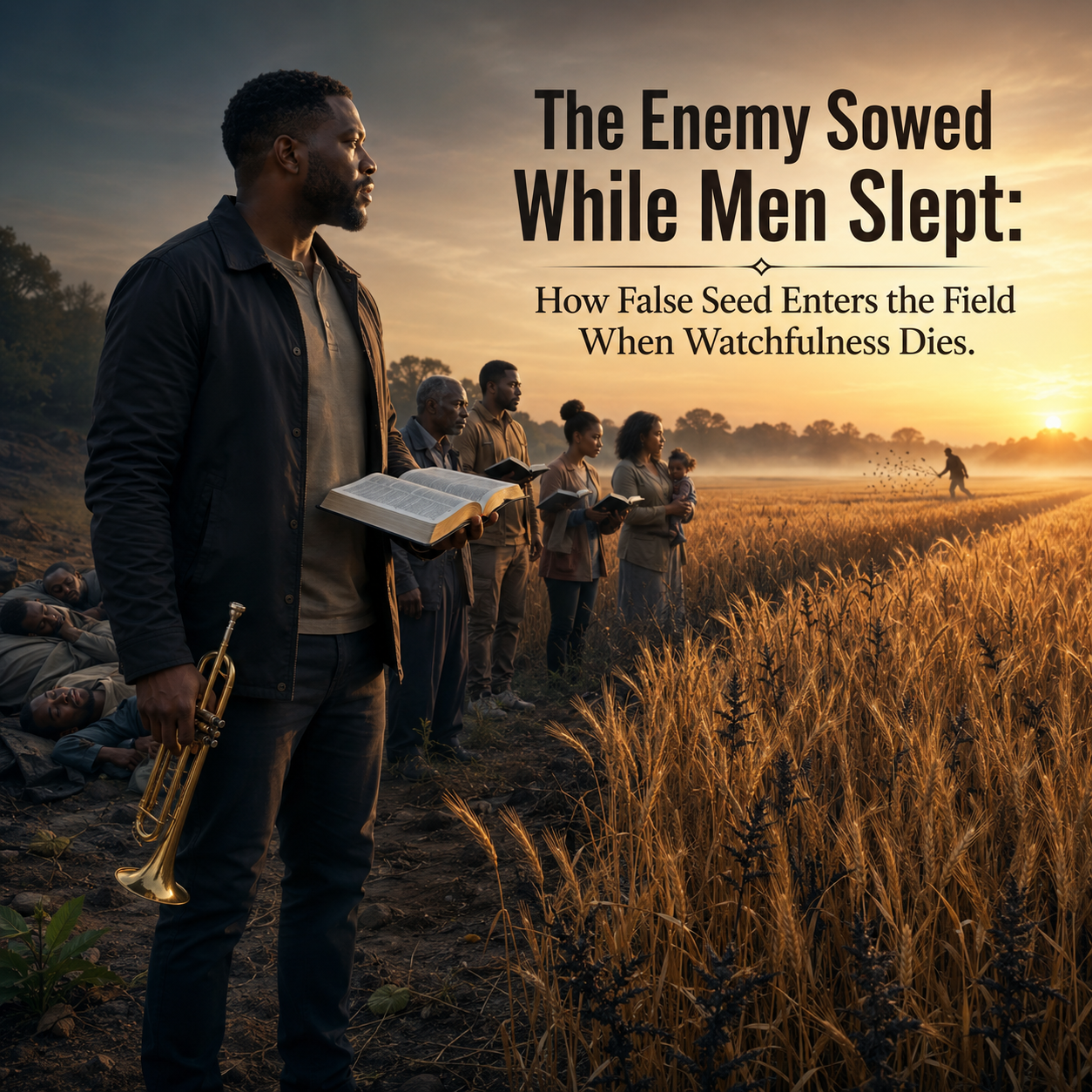
- The Enemy Sowed While Men Slept: How False Seed Enters the Field When Watchfulness Dies
- Another Gospel: When Good News Stops Calling Men to Repent
- Another Spirit: Testing the Fire Before You Call It Holy
- Another Jesus: The Messiah the Flesh Can Tolerate
- Lord, Lord, But Lawlessness: How Religious Activity Can Hide a Rebellious Heart
- Strange Fire Beside the Altar: How Mixture Turns Worship Into Contamination
- The Fruit Tells on the Root: How the Seed Eventually Reveals Itself Through Fruit
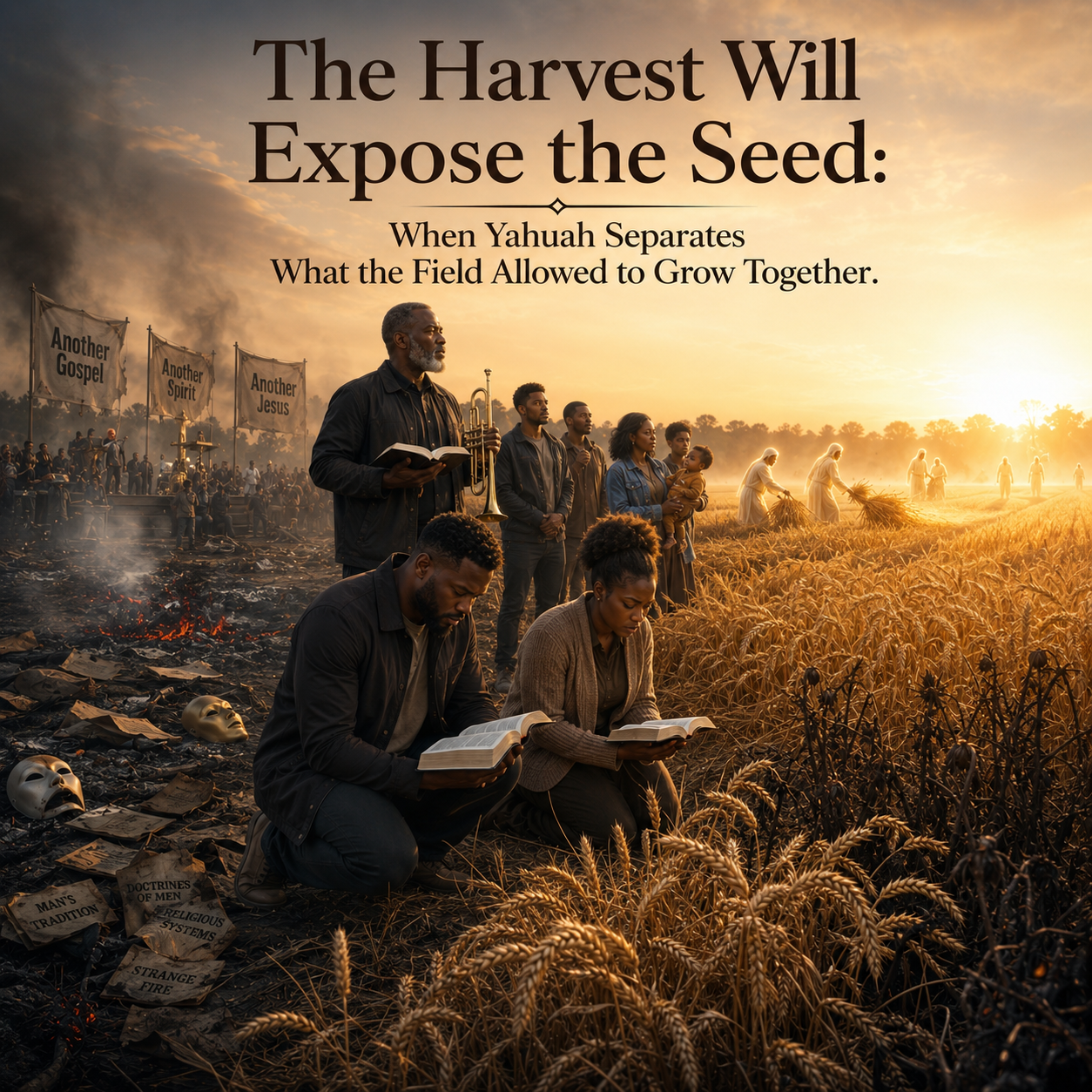
- The Harvest Will Expose the Seed: When Yahuah Separates What the Field Allowed to Grow Together
Shalom mishpacha. Today we begin this series with the words of Yahusha (Jesus), because before we talk about another gospel, another spirit, and another Jesus, we have to understand the field. We have to understand the seed. We have to understand the enemy’s strategy. And we have to understand why the Master said the tares were not planted in some separate place far away from the wheat, but right there among it.
That is the part that should make us sober.
Because if the tares were planted in another field, discernment would be easy. We could just point at the other field and say, “That over there is false.” But Yahusha did not teach it that way. He said the enemy sowed tares among the wheat. That means the counterfeit grows close to the true. False worship grows beside true worship. Another gospel grows beside the true Besorah. Another spirit operates near the place where people claim the Ruach. Another Jesus is preached in spaces where people still open Bibles, sing songs, gather crowds, and say, “Lord, Lord.”
That is why this study has to begin with the warning: a sleeping field becomes easy soil for false seed.
Mattithyahu (Matthew) 13:24–25 says that the Kingdom of Heaven is like a man who sowed good seed in his field, but while men slept, his enemy came and sowed tares among the wheat and went his way.
Beside this, we place Bereshith (Genesis) 3:15, where Yahuah speaks of the seed of the woman and the seed of the serpent.
Beside this, we place Yochanan Aleph (1 John) 3:10, where Scripture says the children of Elohim and the children of the devil are made manifest.
Beside this, we place Mattithyahu (Matthew) 7:16, where Yahusha says, “Ye shall know them by their fruits.”
So from the beginning, the issue is seed.
Not just location. Not just appearance. Not just religious vocabulary. Not just emotional moments. Seed.
The seed determines the nature. The nature produces the fruit. The fruit exposes the root. And the root reveals who planted it.
This is why the enemy does not always come swinging a sword in the open. Sometimes he comes with seed in the dark. Sometimes he waits until men stop watching. Sometimes he waits until the household gets comfortable. Sometimes he waits until the shepherds get distracted. Sometimes he waits until the people are entertained but not equipped, emotional but not rooted, gathered but not guarded.
Then he sows.
And notice what Yahusha said: the enemy sowed while men slept.
That is a whole sermon by itself.
The enemy did not need to own the field. He only needed access while the field was unguarded. He did not need permission from the Master. He only needed negligence from the servants. He did not have to uproot the wheat immediately. He only needed to plant something close enough to the wheat that it could grow beside it and confuse the eye until maturity revealed the difference.
That is how false worship works.
False worship does not always begin by denying Yahuah. Sometimes it begins by changing how people approach Him. It begins by mixing His Word with man’s tradition. It begins by replacing obedience with performance. It begins by turning repentance into emotion. It begins by using Scripture language while removing Scripture authority.
The tare does not have to look like a thorn bush at first. It only has to look enough like wheat to avoid being questioned.
That is why watchfulness matters.
Mattithyahu (26:41) says, “Watch and pray, that ye enter not into temptation.”
Beside this, we place Romiyim (Romans) 13:11, which says it is high time to awake out of sleep.
Beside this, we place Kepha Aleph (1 Peter) 5:8, which says to be sober and vigilant because the adversary walks about seeking whom he may devour.
Beside this, we place Marqus (Mark) 13:37, where Yahusha says, “What I say unto you I say unto all, Watch.”
The command to watch is not optional. Watchfulness is covenant responsibility.
A watchman does not watch because he is paranoid. He watches because the sheep are valuable. He watches because the house matters. He watches because the enemy is real. He watches because the Master gave him something to guard.
And this is where many fields become vulnerable. People stop guarding what Yahuah gave them.
They stop guarding the Word.
They stop guarding doctrine.
They stop guarding the children.
They stop guarding the home.
They stop guarding worship.
They stop guarding the difference between clean and unclean, holy and profane, truth and mixture.
They stop guarding the gate of the heart.
And once the gate is unguarded, the enemy does not need to kick the door down. He just slips seed into the soil.
Mishpacha, we have to say this plainly: the enemy is not only after your moment. He is after your harvest.
He knows seed takes time. He knows a little false doctrine may not look dangerous the first day. He knows a little compromise may not feel deadly the first week. He knows a little bitterness may not seem like a root at first. He knows a little mixture may still look religious in the beginning.
But seed grows.
A thought becomes a belief.
A belief becomes a practice.
A practice becomes a culture.
A culture becomes a stronghold.
A stronghold becomes an inheritance if nobody repents.
That is how tares take over fields. Not always by sudden invasion, but by quiet planting.
Galatiyim (Galatians) 6:7–8 says whatever a man sows, that shall he also reap. The one who sows to the flesh reaps corruption, but the one who sows to the Ruach reaps life.
Beside this, we place Ya’aqob (James) 1:14–15, where desire conceives and brings forth sin, and sin brings forth death.
Beside this, we place Hoshea (Hosea) 8:7, which says they have sown the wind and shall reap the whirlwind.
Beside this, we place Mishlei (Proverbs) 22:8, which says the one who sows iniquity shall reap vanity.
Seed becomes harvest. That is not just agricultural language. That is spiritual law.
So when Yahusha says the enemy sowed tares, He is teaching us that falsehood has a growth cycle. Deception gets planted. Then it takes root. Then it matures. Then it produces after its own kind.
That is why false worship is so dangerous when it is tolerated early.
At first, people say, “It is not that serious.”
Then they say, “Everybody does it.”
Then they say, “Yahuah knows my heart.”
Then they say, “Do not judge.”
Then they say, “That is old.”
Then they say, “We are under grace.”
Then they say, “It does not matter.”
And before long, what began as compromise becomes doctrine. What began as mixture becomes identity. What began as disobedience becomes tradition. And what began as false seed becomes a field full of tares calling itself wheat.
That is why we cannot sleep.
Sleep in Scripture often points to dullness, carelessness, and lack of spiritual alertness. There is natural sleep, yes, but there is also spiritual sleep. Spiritual sleep is when the body is moving but discernment is off. Spiritual sleep is when people are busy but not watchful. Spiritual sleep is when religion is active but obedience is absent. Spiritual sleep is when people hear the Word but do not tremble at it.
Yesha’yahu (Isaiah) 29:13 says the people draw near with their mouth and honor Yahuah with their lips, but their heart is far from Him, and their fear toward Him is taught by the commandment of men.
Beside this, we place Yechezqel (Ezekiel) 33:31, where the people hear words but will not do them.
Beside this, we place Ya’aqob (James) 1:22, which says to be doers of the Word and not hearers only, deceiving ourselves.
Beside this, we place Mattithyahu (Matthew) 15:8–9, where Yahusha says people worship in vain when teaching the commandments of men.
That is sleeping religion.
It speaks. It gathers. It sings. It listens. It may even agree. But it does not obey.
And where obedience dies, tares grow easily.
Because the Word is not just information. The Word is a sword, a lamp, a seed, a washing, a witness, and a boundary. When people stop obeying the Word, they lose the boundary that keeps false seed from being welcomed as truth.
Tehillim (Psalm) 119:105 says, “Thy word is a lamp unto my feet, and a light unto my path.”
Beside this, we place Ibrim (Hebrews) 4:12, where the Word is living and powerful, discerning the thoughts and intents of the heart.
Beside this, we place Eph’siyim (Ephesians) 5:26, where Messiah cleanses by the washing of water by the Word.
Beside this, we place Yesha’yahu (Isaiah) 8:20, “To the Torah and to the testimony.”
When the lamp is ignored, darkness has room.
When the sword is laid down, wolves have room.
When the washing is despised, uncleanness has room.
When the testimony is replaced by tradition, deception has room.
The enemy sowed while men slept because sleeping men do not test seed.
That is one of the clearest warnings in this study: sleeping men do not test seed.
They receive whatever sounds spiritual.
They trust whatever has a crowd.
They assume whatever has a title.
They follow whatever produces a feeling.
They defend whatever is familiar.
But Scripture commands the opposite.
Thessaloniqim Aleph (1 Thessalonians) 5:21 says, “Prove all things; hold fast that which is good.”
Beside this, we place Yochanan Aleph (1 John) 4:1, which says not to believe every spirit, but to test the spirits.
Beside this, we place Ma’aseh (Acts) 17:11, where the Bereans searched the Scriptures daily to see whether the teaching was true.
Beside this, we place Qorintiyim Aleph (1 Corinthians) 2:15, which says the spiritual man judges all things.
The people of Yahuah are not called to be gullible. We are called to be humble, but not blind. Loving, but not careless. Patient, but not passive. Slow to accuse, but quick to test.
Discernment is not hatred.
Discernment is how love guards the house.
If a mother checks what her child is eating, nobody calls that hatred. If a shepherd checks the field for wolves, nobody calls that bitterness. If a watchman sees smoke in the distance and sounds the alarm, nobody says he is being negative. But when it comes to doctrine, spirits, worship, and the condition of the field, suddenly people say, “Do not judge.”
But Yahusha did not say, “Ignore fruit.” He said, “Ye shall know them by their fruits.”
Mattithyahu (Matthew) 7:15–20 says false prophets come in sheep’s clothing, but inwardly they are ravening wolves. Yahusha says the good tree brings good fruit, and the corrupt tree brings evil fruit.
Beside this, we place Yochanan Aleph (1 John) 3:7–10, where righteousness and sin reveal who one belongs to.
Beside this, we place Galatiyim (Galatians) 5:19–23, where the works of the flesh are contrasted with the fruit of the Ruach.
Beside this, we place Ya’aqob (James) 3:11–18, where bitter envying, strife, and confusion are contrasted with wisdom from above.
This is how we watch.
We do not watch by suspicion alone. We watch by Scripture. We watch by fruit. We watch by obedience. We watch by whether the seed produces what Yahuah says it should produce.
Does the teaching produce repentance or excuses?
Does it produce humility or arrogance?
Does it produce obedience or lawlessness?
Does it produce clean worship or mixture?
Does it point people back to Yahuah through Yahusha, or does it make people dependent on personalities, platforms, and systems?
Does it cause people to search the Scriptures, or does it train them to outsource discernment?
Does it expose sin, or does it comfort sin?
Does it produce the fruit of the Ruach, or does it merely produce noise?
Because a field can be loud and still be asleep.
A gathering can be emotional and still be unguarded.
A people can be active and still not awake.
Yahusha said the enemy sowed while men slept. That means one of the greatest protections against false seed is spiritual wakefulness.
And wakefulness begins with trembling at the Word.
Yesha’yahu (Isaiah) 66:2 says Yahuah looks to the one who is poor, contrite in spirit, and trembles at His Word.
Beside this, we place Tehillim (Psalm) 51:17, where a broken and contrite heart is not despised.
Beside this, we place Mishlei (Proverbs) 1:7, which says the fear of Yahuah is the beginning of knowledge.
Beside this, we place Debarim (Deuteronomy) 10:12–13, where Yahuah requires His people to fear Him, walk in His ways, love Him, serve Him, and keep His commandments.
The awake person trembles.
The sleeping person argues.
The awake person says, “Search me.”
The sleeping person says, “Do not correct me.”
The awake person brings doctrine back to the Word.
The sleeping person brings the Word under tradition.
The awake person wants truth even when it cuts.
The sleeping person wants comfort even when it lies.
That is why some people will defend tares before they ever examine the seed. They are not defending truth. They are defending familiarity.
And this is especially heavy for a people coming out of inherited lies. Because sometimes the field we were born into already had tares growing. We did not plant all of them. Some of them were handed to us. Some were taught to us as children. Some came through religious systems. Some came through culture. Some came through trauma. Some came through fear. Some came through leaders who were also misled.
But once Yahuah shines light, responsibility begins.
Ma’aseh (Acts) 17:30 says that Elohim once overlooked the times of ignorance, but now commands all men everywhere to repent.
Beside this, we place Yirmeyahu (Jeremiah) 16:19, where the nations will say they inherited lies, vanity, and things wherein there is no profit.
Beside this, we place Mishlei (Proverbs) 28:13, where the one who confesses and forsakes sin receives mercy.
Beside this, we place Chazon (Revelation) 18:4, where the call goes forth, “Come out of her, my people.”
Once truth comes, we cannot keep sleeping and call it innocence.
There is mercy for ignorance. There is correction for error. There is forgiveness for repentance. But there is danger in defending deception after the Word has exposed it.
That is why this first part is not just about identifying tares “out there.” It is about asking Yahuah to wake us up “in here.”
Because the enemy does not only sow false doctrine in institutions. He sows false seed in hearts.
He sows bitterness and calls it discernment.
He sows pride and calls it awakening.
He sows rebellion and calls it freedom.
He sows fear and calls it wisdom.
He sows hatred and calls it truth.
He sows laziness and calls it peace.
He sows mixture and calls it balance.
He sows confusion and calls it mystery.
And if the heart is sleeping, the seed can grow.
Yirmeyahu (Jeremiah) 17:9–10 says the heart is deceitful above all things, and Yahuah searches the heart and tries the reins.
Beside this, we place Tehillim (Psalm) 139:23–24, where Dawid says, “Search me, O El, and know my heart.”
Beside this, we place Qorintiyim Sheniy (2 Corinthians) 10:4–5, where we are told to cast down imaginations and bring every thought captive.
Beside this, we place Ibrim (Hebrews) 12:15, where a root of bitterness can spring up and defile many.
So the field is not only the public assembly. The field is also the household. The field is also the mind. The field is also the heart. The field is also the children. The field is also the teaching table. The field is also the music. The field is also the habits. The field is also what we tolerate when nobody is watching.
And if we do not guard the field, we cannot act shocked when strange things begin growing.
That is what the servants asked in Mattithyahu (Matthew) 13:27. They said, “Sir, didst not thou sow good seed in thy field? from whence then hath it tares?”
That question is still being asked today.
How did false worship grow in a place where Scripture was read?
How did lawlessness grow in a place where people said Messiah?
How did pride grow in a place that talked about awakening?
How did mixture grow in a place that claimed covenant?
How did another gospel grow in a place where the Bible was open?
How did another spirit move in a place where people said “holy”?
How did another Jesus get preached in a place where people thought they were following the truth?
Yahusha already answered: an enemy has done this.
But He also showed when it happened: while men slept.
So we cannot only blame the enemy and ignore the sleep.
Yes, the enemy sowed.
But who was watching?
Who was testing?
Who was guarding?
Who was searching the Scriptures?
Who was correcting the children?
Who was warning the people?
Who was willing to be called extreme in order to stay faithful?
Who loved the sheep enough to risk being misunderstood?
Because when watchmen are silent, fields get contaminated.
Yechezqel (Ezekiel) 33:6 says if the watchman sees the sword and does not blow the trumpet, the blood is required at the watchman’s hand.
Beside this, we place Yesha’yahu (Isaiah) 62:6, where Yahuah sets watchmen on the walls who shall not hold their peace.
Beside this, we place Chabaqquq (Habakkuk) 2:1, where the prophet says he will stand upon his watch.
Beside this, we place Ma’aseh (Acts) 20:28–31, where Sha’ul warns the elders to watch because grievous wolves would enter and men would arise speaking perverse things.
That word in Acts is powerful because Sha’ul did not only warn about enemies from the outside. He warned that men would arise from among them, speaking twisted things to draw disciples after themselves.
That is the tare pattern.
From among.
Close enough to be trusted.
Religious enough to sound familiar.
Gifted enough to attract attention.
But twisted enough to pull people away from the Shepherd and toward themselves.
So the people of Yahuah must learn to recognize the difference between a servant who points to the Master and a tare system that gathers people around itself.
A true servant says, “Search the Scriptures.”
A false servant says, “Trust my title.”
A true servant says, “Follow Yahusha.”
A false servant says, “Follow my platform.”
A true servant welcomes correction from the Word.
A false servant attacks anyone who tests the seed.
A true servant feeds sheep.
A false servant harvests sheep.
And this is where we need courage, because testing seed will make some people uncomfortable. When you start asking, “Where is that written?” people will call you divisive. When you start asking, “What fruit is this producing?” people will say you are judging. When you start asking, “Is this the Yahusha of Scripture or a version shaped by tradition?” people may say you are doing too much.
But mishpacha, when the harvest comes, “doing too much” will not be the problem.
Sleeping will be the problem.
Ignoring will be the problem.
Defending false seed will be the problem.
Calling mixture harmless will be the problem.
Letting another gospel grow beside truth without warning will be the problem.
This is why we must return to the simple, ancient posture: watch and pray.
Watch the doctrine.
Watch the fruit.
Watch the spirit.
Watch the worship.
Watch the heart.
Watch the home.
Watch what is being planted in the children.
Watch what is being normalized.
Watch what is being called love.
Watch what is being called grace.
Watch what is being called freedom.
Watch what is being called truth.
And pray.
Because watchfulness without prayer can become suspicion. Prayer without watchfulness can become passivity. But together, watchfulness and prayer make the servant sober.
Yahusha did not say, “Watch only.” He said, “Watch and pray.”
Prayer keeps the watchman humble. Watchfulness keeps the prayerful from being naive.
We need both.
And we need patience too, because in the parable the servants wanted to pull up the tares immediately, but the Master said not yet, lest they root up the wheat also. That teaches us that discernment must walk with wisdom. We do not get to destroy the field in our zeal to expose the tares. We do not rip people apart based on immature appearances. We do not confuse suspicion with judgment. We do not make ourselves the harvest.
The harvest belongs to Yahuah.
Mattithyahu (Matthew) 13:30 says, “Let both grow together until the harvest.”
Beside this, we place Qorintiyim Aleph (1 Corinthians) 4:5, which says not to judge before the time, until Yahuah brings hidden things to light.
Beside this, we place Qoheleth (Ecclesiastes) 12:14, which says Elohim will bring every work into judgment.
Beside this, we place Ibrim (Hebrews) 4:13, where all things are naked and opened before Him.
So we do not appoint ourselves as the reapers. But we also do not sleep in the field.
That balance matters.
We warn. We test. We teach. We guard. We repent. We come out of mixture. We examine fruit. We blow the trumpet when the sword is coming. But we leave final separation to Yahuah.
That keeps us from pride.
Because the moment discernment becomes arrogance, the enemy has planted another seed.
The moment awakening becomes superiority, the enemy has planted another seed.
The moment correction becomes cruelty, the enemy has planted another seed.
The moment truth is spoken without love, without humility, without fear of Yahuah, the enemy is trying to corrupt even the messenger.
So yes, we must expose false seed, but first we must let the Word search our own field.
Tehillim (Psalm) 139:23–24 says, “Search me, O El, and know my heart… and lead me in the way everlasting.”
Beside this, we place Tehillim (Psalm) 51:10, where Dawid asks for a clean heart.
Beside this, we place Mishlei (Proverbs) 4:23, which says to keep the heart with all diligence.
Beside this, we place Yirmeyahu (Jeremiah) 31:33, where Yahuah says He will put His Torah in the inward parts and write it in the heart.
This is the prayer of wheat.
Search me.
Clean me.
Write Your Word in me.
Lead me.
That is not the language of the tare. The tare wants to stay hidden. The wheat is willing to be examined.
The tare resists exposure. The wheat welcomes pruning.
The tare wants the field without submission to the Master. The wheat bends when it matures.
The tare can imitate the shape, but it cannot produce the grain.
And that brings us to the final charge of Part 1: wake up before the harvest does what correction was sent to do earlier.
Yahuah is merciful to warn before He separates. He sends the Word before the sickle. He sends conviction before judgment. He sends watchmen before destruction. He sends light before the final exposure.
So do not despise the warning.
Do not defend the sleep.
Do not protect the false seed because it is familiar.
Do not call the enemy’s planting “tradition” just because it has been growing for generations.
Do not call mixture “balance.”
Do not call rebellion “grace.”
Do not call lawlessness “freedom.”
Do not call another spirit “revival.”
Do not call another gospel “love.”
And do not call another Jesus “the Messiah of Scripture” if that version leads people away from the Father, away from obedience, away from covenant, and away from the Word.
The enemy sowed while men slept.
But Yahuah is waking His people.
He is waking households.
He is waking watchmen.
He is waking fathers and mothers.
He is waking sons and daughters.
He is waking those who inherited lies and are now hearing the ancient call: return.
Return to the Word.
Return to covenant.
Return to obedience.
Return to the Shepherd’s voice.
Return to the field with your eyes open.
Because the wheat does not need to fear the harvest if it belongs to the Master. But the wheat does need to mature. The wheat does need to endure. The wheat does need to stay rooted. The wheat does need to stop sleeping while false seed is being planted around it.
The enemy sowed while men slept.
So wake up, mishpacha.
Guard the field.
Test the seed.
Watch and pray.
Let the Word search your own heart first.
And remember this: a sleeping field becomes easy soil for false seed, but an awakened people become watchmen in the hand of Yahuah.
Let us close with prayer.
Abba Yahuah, wake us up.
Search our hearts and search our homes. Search what we have believed, what we have tolerated, what we have inherited, and what we have defended without testing it by Your Word. Wherever false seed has been planted in us, expose it by mercy before the harvest exposes it by judgment.
Make us sober and vigilant. Teach us to watch and pray. Give us discernment without pride, courage without cruelty, and love without compromise. Do not let us become careless with Your field. Do not let us sleep while the enemy sows. Do not let us call mixture harmless or false worship acceptable.
Bring us back to Your Word. Bring us back to the voice of Yahusha. Bring us back to obedience from the heart. Write Your Torah within us. Cleanse us from inherited lies. Break agreement with another gospel, another spirit, and another Jesus.
Make us wheat that bows under Your hand. Make us servants who guard what You have planted. Make us watchmen who sound the trumpet with humility and truth.
In the name of Yahusha Ha’Mashiach, wake up Your people, guard Your field, and let every false seed be exposed before the harvest. Amein.


Leave a Reply