
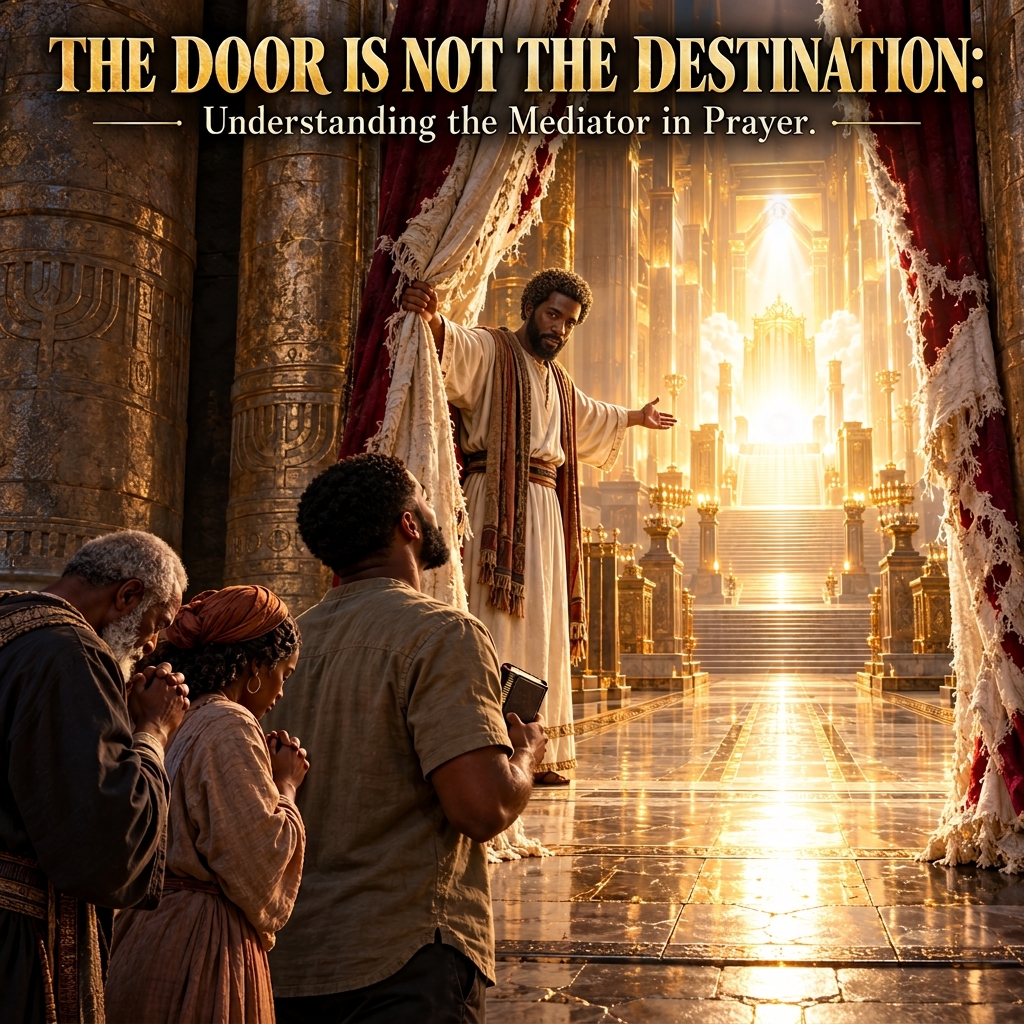
The Father Is the One We Approach. Yahusha Is the Way We Are Granted Access.
Shalom mishpacha. Come, let us seek the ancient path where the Word interprets the Word, line upon line, precept upon precept.
Beloved, there is something we need to examine carefully, because sometimes a practice becomes so familiar that people stop asking whether it follows the instructions given in Scripture.
Millions of people have been taught to pray in the name of the Messiah. But how many have actually stopped to examine what that instruction means? Who is receiving the prayer? Who is presenting the petition? Who grants access? And what exactly is Yahusha (Jesus) doing as our mediator?
These are not small questions.
They concern the relationship between the Father, His appointed Son, the covenant, the priesthood, and the access that has been provided to those who believe.
Many people have inherited a pattern of prayer without ever examining its foundation. They repeat what they have heard. They follow what they have seen. They assume that because a practice is widespread, it must be precisely what the Messiah taught.
But repetition does not establish truth.
A practice can become familiar without ever becoming Scriptural.
And sometimes the most uncomfortable question we can ask is also the most necessary:
Are we praying according to the instructions of Yahusha (Jesus), or according to what generations of religious tradition have taught us to say?
Now imagine something with me.
There is a sovereign king who rules from a magnificent palace. His authority governs the entire kingdom. His judgments are final. His word determines what happens throughout the land.
Outside the palace stands an ordinary citizen.
That citizen has a petition.
Perhaps his household is suffering. Perhaps he needs mercy. Perhaps he has committed an offense and seeks forgiveness. Perhaps he has a matter that only the sovereign has authority to resolve.
He approaches the palace, but between him and the throne stands a guarded entrance.
The citizen cannot simply claim the king’s authority as his own. He cannot force his way into the royal chamber. He cannot demand an audience on the basis of his personal importance.
He needs authorized access.
Now imagine that the king himself has appointed someone to receive those seeking entrance and bring them into his presence.
This appointed representative has authority from the king. He knows the king’s will. He has been entrusted with the means by which the citizen may approach.
The representative opens the entrance.
The citizen is brought before the throne.
But here is where our illustration becomes important.
The citizen did not approach the palace because he wanted to spend his time speaking to the entrance.
He came because he needed to petition the sovereign.
The entrance made the audience possible.
The appointed representative made the approach possible.
But the sovereign remains the one to whom the petition is directed.
Now carry that picture into the Scriptures.
Yahuah (Elohim) is the sovereign Father.
Yahusha (Jesus) is the appointed mediator, the high priest, and the way of access.
And those who come through him are being brought into relationship with the Father.
The purpose of the door is not to keep you standing outside admiring the entrance. The purpose of the door is to bring you into the presence of the One who opened it.
But before we go any further, we need to make one distinction clear.
Yahusha is not a lifeless door, an ordinary gate, or merely a messenger carrying paperwork between two offices. He is the living Messiah, the Son whom the Father appointed, who gave himself for our redemption and now serves as high priest.
Our illustration explains the direction of access. It does not exhaust the dignity or authority of the Son.
And Scripture, not the illustration, must have the final word.
Let us begin where Yahusha began.
Mattithyahu (Matthew) 6:6 records his instruction:
“But thou, when thou prayest, enter into thy closet, and when thou hast shut thy door, pray to thy Father which is in secret.”
Notice the instruction.
Pray to whom?
Your Father.
Not an angel.
Not a deceased ancestor.
Not a religious official.
Not a heavenly being of your own choosing.
Your Father.
And notice something else.
Yahusha did not describe the Father as a distant sovereign who had no desire to hear His children.
He described Him as the Father who sees in secret.
Let that settle in your spirit.
The Father sees.
The Father knows.
The Father hears.
The Father is not ignorant of the condition of those who seek Him.
And Yahusha does not teach his disciples to hide their needs from the Father. He teaches them how to approach Him.
Beside this instruction, consider Mattithyahu (Matthew) 6:8, where Yahusha says the Father already knows what His children need before they ask.
And then, in Mattithyahu (Matthew) 6:9, he provides the pattern:
“After this manner therefore pray ye: Our Father which art in heaven, Hallowed be thy name.”
Beloved, that opening is not accidental.
He begins with the Father.
He identifies the One being addressed.
He honors the Father’s name.
He calls for the Father’s reign and will to be established.
He asks for provision, forgiveness, and deliverance.
And the prayer is directed to the Father from beginning to end.
The supporting witnesses are just as clear.
Luqas (Luke) 11:1–2 — When the disciples ask Yahusha to teach them to pray, he directs them to address the Father.
Mattithyahu (Matthew) 6:10 — The prayer seeks the Father’s kingdom and the fulfillment of His will.
Mattithyahu (Matthew) 7:11 — Yahusha teaches that the heavenly Father gives good things to those who ask Him.
Yochanan (John) 4:23 — Yahusha speaks of true worshipers worshiping the Father in spirit and truth.
Now ask yourself something.
If Yahusha intended his followers to make him the ordinary recipient of their petitions, why would he establish this pattern so plainly?
Why teach them to address the Father?
Why emphasize that the Father knows their needs?
Why teach them to seek the Father’s will?
And why repeatedly direct their attention beyond himself to the One who sent him?
This is where we must distinguish between what Yahusha taught and what people may have assumed from later customs.
The Messiah did not come to make the Father unreachable. He came to reveal the Father and bring people near to Him.
Consider Yochanan (John) 14:6:
“I am the way, the truth, and the life: no man cometh unto the Father, but by me.”
This is one of the strongest statements concerning the Messiah’s place in the covenant.
But listen carefully to its direction.
He does not say that the Father is the way to him.
He says no one comes to the Father except through him.
There is an origin.
There is an appointed way.
And there is the One being approached.
The statement is not merely about identifying the Messiah. It explains the relationship between the Messiah and the Father.
Yahusha is the way.
The Father is the One to whom that way leads.
Supporting this, Yochanan (John) 10:9 records Yahusha identifying himself as the door through which the sheep enter and find safety.
Beside that, Kepha Aleph (1 Peter) 3:18 says that the Messiah suffered for sins to bring us to Elohim.
And Eph’siyim (Ephesians) 2:18 gives the relationship with remarkable precision:
“For through him we both have access by one Spirit unto the Father.”
Read that again.
Through him.
By one Spirit.
Unto the Father.
That is the pattern.
Not merely a religious slogan.
Not a denominational formula.
Not a tradition built upon centuries of repetition.
That is the direction described in Scripture.
Through the Son does not mean away from the Father. It means access to the Father because of the Son.
And this raises another important question.
Why do we need a mediator in the first place?
To answer that, we must return to the covenant and the priesthood.
Under the instructions given to Yisra’el, the presence of Yahuah was not treated casually.
The tabernacle had boundaries.
The sanctuary had appointed service.
The priesthood had responsibilities.
And the Most Set-Apart Place was not an ordinary room into which anyone could wander whenever they pleased.
Wayyiqra (Leviticus) 16:2 explains that Aharon was not to enter the innermost sanctuary at whatever time he chose.
Wayyiqra (Leviticus) 16:29–34 establishes the annual Day of Atonement, when the appointed high priest performed the prescribed service for cleansing and atonement.
Shemoth (Exodus) 28:29 describes Aharon carrying the names of the children of Yisra’el before Yahuah upon his heart.
Bemidbar (Numbers) 18:7 establishes the priestly responsibility associated with the altar and the sanctuary.
The point was not that Yahuah had no desire to hear His people.
After all, the Scriptures repeatedly record people praying directly to Him.
Chanah prayed in the sanctuary.
Dawid cried out in repentance.
Dani’el sought His mercy.
The prophets called upon Him.
Therefore, we should not confuse restricted entrance into the earthly Most Set-Apart Place with a claim that nobody could ever address Yahuah in prayer before the Messiah came.
The priestly restrictions taught something more specific.
The presence of the Set-Apart One cannot be approached on human terms.
Sin matters.
Atonement matters.
Holiness matters.
And the appointed means of drawing near matters.
This is why Yeshayahu (Isaiah) 59:2 describes iniquities as creating separation between a people and their Elohim.
Supporting that, Tehillim (Psalm) 24:3–4 asks who may ascend Yahuah’s hill and stand in His set-apart place, then describes clean hands and a pure heart.
And Tehillim (Psalm) 51:17 reminds us that a broken and contrite heart is not despised by Elohim.
Do you see the balance?
The Father is not unwilling to hear.
But human beings cannot declare themselves holy simply because they wish to approach Him.
The barrier is not a lack of love in the Father.
The problem is sin, guilt, and the human inability to establish our own righteousness.
And this is where the role of Yahusha becomes essential.
The mediator is not evidence that the Father refuses to love us. The mediator is evidence that the Father has provided a way to restore us.
Now come to Timotheos Aleph (1 Timothy) 2:5–6:
“For there is one Elohim, and one mediator between Elohim and men, the man Messiah Yahusha; who gave himself a ransom for all.”
Notice the distinctions being made.
One Elohim.
One mediator between Elohim and humanity.
The Messiah, Yahusha.
And a ransom given.
A mediator stands in relation to parties who require reconciliation.
His office is meaningful precisely because there is a distinction between the One to whom reconciliation is made and those who need to be reconciled.
And Scripture identifies Yahusha as the appointed mediator.
He does not appoint himself apart from the Father.
He comes according to the Father’s will.
He gives himself in obedience.
He is raised and exalted.
And he now serves in the position established for him.
Beside this, examine the witnesses.
Timotheos Aleph (1 Timothy) 2:3–4 — The one Elohim is identified as our Savior, who desires people to come to knowledge of the truth.
Yochanan (John) 17:3 — Yahusha addresses the Father as the only true Elohim and identifies himself as the one whom the Father sent.
Ma’aseh (Acts) 2:36 — Kepha declares that Elohim made the crucified Yahusha both Master and Messiah.
Philippians 2:9–11 — Elohim highly exalted Yahusha, and the Son’s exaltation brings glory to Elohim the Father.
The Son’s appointment is not a small detail.
It is the reason his mediation has authority.
You cannot honor the appointment while erasing the One who appointed him.
And neither can you claim to honor the Father while disregarding the Son through whom the Father has chosen to reconcile His people.
These truths belong together.
The Father is the source.
The Son is the appointed way.
The covenant gives us the framework for understanding their relationship.
Now let us go deeper into the high priesthood.
Ibrim (Hebrews) 4:14–16 identifies Yahusha as the great high priest and encourages believers to approach the throne of grace with confidence to receive mercy and help.
Notice what that passage does not teach.
It does not say that the believer becomes the high priest.
It does not say the believer no longer needs the high priest.
And it does not teach that the Messiah’s priesthood has become irrelevant.
Quite the opposite.
Because there is a great high priest, the believer is encouraged to approach.
His priesthood is the basis of confidence.
Supporting witnesses make this even clearer.
Ibrim (Hebrews) 7:25 — Yahusha is able to save those who come to Elohim through him, and he lives to make intercession for them.
Ibrim (Hebrews) 8:1–2 — The high priest is seated at the right hand of the throne of the Majesty in heaven and serves in the heavenly sanctuary.
Ibrim (Hebrews) 9:11–12 — The Messiah enters the greater sanctuary through his own blood, obtaining eternal redemption.
Ibrim (Hebrews) 9:24 — The Messiah appears in the presence of Elohim on our behalf.
Now hold those passages together.
He is the high priest.
He makes intercession.
He appears before Elohim on our behalf.
And through him we draw near.
The direction remains consistent.
But we need to be careful about a common misunderstanding here.
Intercession does not mean the Father hates His children and must be persuaded by a more compassionate Son.
It does not mean Yahusha is trying to calm down an unwilling Father every time someone prays.
Yahusha himself corrects that kind of thinking in Yochanan 16.
The Father’s love is not an obstacle the Messiah must overcome.
The Father’s love is part of the reason the Messiah was sent.
Yochanan (John) 3:16 begins with the love of Elohim for the world.
Romiyim (Romans) 5:8 describes Elohim demonstrating His love through the Messiah’s death for sinners.
Yochanan Aleph (1 John) 4:9–10 presents the sending of the Son as the manifestation of Elohim’s love and initiative.
So do not imagine the mediator as someone fighting against the Father’s desire to show mercy.
The Father established the way of reconciliation.
The Son faithfully fulfilled his appointed work.
And the believer is invited to come near.
The Son is not protecting us from a Father who refuses to hear. The Son is reconciling us to the Father who sent him.
Now we must examine the veil.
Because this is where the palace illustration becomes even more meaningful.
Ibrim (Hebrews) 10:19–22 declares that believers have confidence to enter the Most Set-Apart Place through the blood of Yahusha, by the new and living way opened through the veil, and because they have a great high priest over the house of Elohim.
Then comes the invitation:
“Let us draw near.”
Not remain distant.
Not pretend we can enter through self-righteousness.
Not turn the high priest into the final object of the petition.
Draw near.
The passage identifies the veil with the Messiah’s flesh in its explanation of the new and living way.
It also identifies his blood and priestly office as fundamental to access.
Beside this, Mattithyahu (Matthew) 27:50–51 records the veil of the temple being torn at the death of Yahusha.
And Romiyim (Romans) 5:1–2 explains that through the Messiah believers have access by faith into grace.
So what has changed?
Not the identity of the Father.
Not His holiness.
Not His righteousness.
And not the need for obedience.
What has changed is the covenantal access provided through the Messiah’s completed offering and continuing priesthood.
Under the earthly priesthood, entry into the innermost sanctuary was restricted to the appointed high priest at the appointed time.
Through the Messiah’s priestly work, believers are invited to draw near to the heavenly throne of grace.
But notice that the text never says the believer may now replace the high priest.
We approach because of him.
We approach through him.
We approach with confidence resting upon what he has accomplished.
You did not tear the veil. You did not offer the perfect sacrifice. You did not appoint the high priest. So do not confuse granted access with personal authority.
That distinction should produce humility, not arrogance.
And it should produce gratitude, not religious pride.
Beloved, when you understand the price of access, you stop treating prayer like a casual demand for whatever the flesh desires.
The throne of grace is not a marketplace where people exchange religious phrases for personal wishes.
Prayer is not a method for controlling the sovereign.
Prayer is an expression of relationship, trust, dependence, reverence, and submission to the will of the Father.
And that brings us to perhaps the clearest statement Yahusha made about the direction of prayer after his departure.
Yochanan (John) 16:23:
“And in that day ye shall ask me nothing. Verily, verily, I say unto you, Whatsoever ye shall ask the Father in my name, he will give it you.”
Do not rush past this.
Yahusha is preparing his disciples for what is coming.
He is explaining the relationship they will have with the Father.
He tells them that they will ask the Father in his name.
Then in Yochanan (John) 16:26–27, he continues:
“At that day ye shall ask in my name: and I say not unto you, that I will pray the Father for you: For the Father himself loveth you.”
Beloved, sit with that.
The Father Himself loves you.
That is a profound correction to the idea that the Father remains inaccessible or emotionally distant unless the Son is constantly persuaded to speak for you.
The Messiah’s mediation does not erase the believer’s personal relationship with the Father.
It establishes the way by which that relationship is enjoyed.
Now place these witnesses beside that passage.
Yochanan (John) 15:16 — Yahusha speaks of the Father giving what is asked in his name.
Yochanan (John) 14:13 — Requests in the Messiah’s name are connected to the Father being glorified in the Son.
Eph’siyim (Ephesians) 3:12 — Through the Messiah believers have boldness and access with confidence through faith in him.
Eph’siyim (Ephesians) 5:20 — Thanksgiving is offered to Elohim the Father in the name of the Master, Yahusha Messiah.
Here is the repeated order.
The prayer is directed toward the Father.
The Messiah’s name establishes the relationship and authority through which the approach is made.
And the Father’s glory remains central.
Now ask a question that deserves serious consideration.
What does it actually mean to pray in Yahusha’s name?
Does it mean that the sound of a particular phrase automatically activates heaven?
Does it mean that the last words spoken at the end of a prayer are a kind of spiritual password?
Does it mean that any desire becomes acceptable as long as a person attaches the Messiah’s name to it?
Of course not.
The Scriptures never present the Messiah’s name as a magical formula.
To act in someone’s name is to act under that person’s authority and in connection with that person’s identity, mission, and will.
When an authorized representative acts in the name of a sovereign, that authority is not independent of the sovereign’s purpose.
And the Messiah does not authorize disobedience simply because someone uses his name.
Consider Yochanan (John) 15:7, where answered prayer is connected with abiding in Yahusha and allowing his words to remain within the disciple.
Supporting that, Yochanan Aleph (1 John) 5:14 says our confidence concerns petitions made according to the will of Elohim.
And Ya’aqob (James) 4:3 warns that people may ask wrongly because their motives are directed toward their own pleasures.
Now look at the lesson.
A rebellious heart cannot turn disobedience into covenant faithfulness by adding a righteous name to the end of its request.
You cannot knowingly reject the Father’s commands, resist the teaching of the Son, and then expect the Son’s name to function as permission for rebellion.
The name is not a password for getting your way. It is the authority under which you surrender to His way.
This is where the discussion moves beyond the words spoken during prayer and reaches into the condition of the heart.
Do you actually want the Father’s will?
Or do you want the Father to approve what you already decided to do?
Are you seeking His wisdom?
Or are you seeking religious confirmation for a choice that has already been made?
Are you approaching through the Messiah in faith and obedience?
Or have you reduced his name to a closing statement that requires no transformation?
Beloved, the difference matters.
Yahusha did not teach his disciples to use prayer as a way of escaping submission to the Father.
He demonstrated submission through prayer.
In Luqas (Luke) 22:42, as he faced suffering, he prayed that the Father’s will would be accomplished rather than his own.
In Yochanan (John) 4:34, he identified his purpose as doing the will of the One who sent him.
In Yochanan (John) 5:30, he explained that he sought the will of the Father who sent him.
And in Yochanan (John) 17:1–5, he prayed to the Father concerning the work he had been given to accomplish.
Look at the life he modeled.
He prayed to the Father.
He obeyed the Father.
He submitted to the Father.
He glorified the Father.
And he taught his disciples to do likewise.
If we claim to follow the Son, we cannot treat the Son’s example as optional.
But now we need to deal with something that can easily be overlooked when teaching this subject.
Some people take the instruction to pray to the Father and turn it into the absolute claim that no believer in Scripture ever addressed the risen Messiah directly.
That claim goes further than the evidence allows.
If we are going to let Scripture interpret Scripture, we cannot stop reading when the passages become inconvenient to our preferred conclusion.
Consider Ma’aseh (Acts) 7:59.
While Stephanos (Stephen) is being stoned, he calls upon Yahusha to receive his spirit.
He is addressing the risen Messiah directly.
We cannot pretend that passage does not exist.
And this was not an ordinary prayer for food, provision, or daily guidance. Stephen was facing death after seeing a vision of the Son of Man standing at the right hand of Elohim.
The context matters.
Beside this, Chizayon (Revelation) 22:20 records the response to the Messiah’s promise of coming: an appeal for him to come.
And Qorintiyim Aleph (1 Corinthians) 1:2 describes believers as those who call upon the name of the Master, Yahusha Messiah, though interpreters discuss exactly how broadly that expression describes prayer and worship.
There is also Yochanan (John) 14:14.
Some manuscript traditions read the verse as Yahusha inviting his disciples to ask him in his name. Other textual traditions omit the word “me.” That textual difference is reflected in English translations.
It would be misleading to act as though the variant does not exist.
And it would also be misleading to use that one debated wording to erase the numerous clear instructions to approach the Father.
So what should we conclude?
The strongest, repeated pattern Yahusha taught for ordinary prayer is to address the Father in the Messiah’s name.
At the same time, the New Testament contains instances of people speaking directly to the risen Messiah.
That means we should be cautious about declaring every direct appeal to Yahusha unlawful or unscriptural.
Different believers understand the theological implications of these passages differently. Some see them as establishing prayer to the Messiah alongside prayer to the Father. Others distinguish exceptional appeals to the risen Messiah from the ordinary prayer pattern Yahusha prescribed.
The passages must be weighed together rather than selectively dismissed.
But whichever interpretation a person reaches, one fact remains unmistakable:
Yahusha explicitly taught his disciples to ask the Father in his name.
And that instruction deserves far more attention than it often receives.
Now consider another important distinction.
Yahusha’s role as mediator does not end with opening access.
He remains the living high priest.
Ibrim (Hebrews) 7:25 tells us he continues to make intercession for those who approach Elohim through him.
Romiyim (Romans) 8:34 speaks of the risen Messiah at the right hand of Elohim, making intercession.
And Yochanan Aleph (1 John) 2:1 describes Yahusha as an advocate with the Father.
So we should not suggest that Yahusha performs one action, unlocks an imaginary door, and then becomes completely irrelevant to the relationship.
That would reduce his priesthood to a momentary transaction.
His sacrifice is decisive.
His priesthood continues.
His intercession matters.
His teaching governs those who follow him.
His authority remains established by the Father.
And his example shows the path of obedience.
But his continuing role does not cancel the Father’s invitation to those who approach through him.
Remember the distinction between an advocate and the person before whom the advocate serves.
Remember the distinction between the appointed priest and the Elohim before whom he ministers.
Remember the distinction between the one who grants access and the one to whom access is granted.
The mediator does not become unnecessary once the door is opened. But neither does the mediator erase the One to whom he brings us.
This is the balance we must preserve.
Now there is another issue hidden beneath this entire discussion.
Many people have become so occupied with the language of religion that they no longer examine the substance of the relationship.
They can tell you how to close a prayer.
They can repeat religious titles.
They can quote phrases they have heard since childhood.
But ask them to explain the difference between the Father and the mediator.
Ask them what a high priest does.
Ask them why the veil mattered.
Ask them why Yahusha told his disciples to ask the Father.
Ask them what intercession means.
And suddenly the conversation becomes uncomfortable.
Beloved, that discomfort is not necessarily a bad thing.
Sometimes confusion must be exposed before understanding can be restored.
But correction must be grounded in the full counsel of Scripture, not merely in a clever analogy.
We must be willing to examine the passages that support our understanding and the passages that challenge it.
Otherwise we will simply replace one inherited assumption with another.
You cannot correct an incomplete tradition by building an incomplete doctrine.
Think about that.
If Scripture says Yahusha is the mediator, we must honor his mediation.
If Scripture says Yahusha is the high priest, we must understand his priesthood.
If Scripture says the Father receives our petitions, we must honor the Father as the recipient.
If Scripture records direct appeals to the risen Messiah, we must acknowledge them.
And if Scripture tells us to pray according to the Father’s will, we cannot reduce the entire issue to who is named first in a sentence.
Truth requires the entire witness.
Now let us trace the central precepts together.
The Father is the One whom Yahusha teaches his disciples to approach in prayer.
Mattithyahu (Matthew) 6:6 — Pray to the Father who sees in secret.
Mattithyahu (Matthew) 6:9 — Address the Father in heaven and honor His name.
Luqas (Luke) 11:2 — Yahusha teaches the disciples to begin with the Father.
Yochanan (John) 16:23 — Ask the Father in Yahusha’s name.
Eph’siyim (Ephesians) 5:20 — Give thanks to Elohim the Father in the Messiah’s name.
Yahusha is the appointed mediator and way of access to the Father.
Yochanan (John) 14:6 — No one comes to the Father except through Yahusha.
Timotheos Aleph (1 Timothy) 2:5 — One Elohim and one mediator between Elohim and humanity.
Eph’siyim (Ephesians) 2:18 — Through the Messiah, access by one Spirit to the Father.
Kepha Aleph (1 Peter) 3:18 — The Messiah suffered to bring us to Elohim.
Romiyim (Romans) 5:2 — Through the Messiah believers have access by faith into grace.
The Messiah’s priesthood and sacrifice establish the basis for approaching the throne of grace.
Ibrim (Hebrews) 4:14–16 — Because of the great high priest, draw near to the throne of grace.
Ibrim (Hebrews) 7:25 — He intercedes for those approaching Elohim through him.
Ibrim (Hebrews) 9:24 — He appears before Elohim on our behalf.
Ibrim (Hebrews) 10:19–22 — His blood and priesthood provide the new and living way to draw near.
Romiyim (Romans) 8:34 — The risen Messiah makes intercession at Elohim’s right hand.
Praying in the Messiah’s name must agree with his teaching and the Father’s will.
Yochanan (John) 14:13 — Prayer in the Messiah’s name is connected to the Father being glorified.
Yochanan (John) 15:7 — Abiding in Yahusha and his words shapes the believer’s petitions.
Yochanan Aleph (1 John) 5:14 — Confidence in prayer is connected to asking according to Elohim’s will.
Ya’aqob (James) 4:3 — Wrong motives can corrupt what a person asks.
Mattithyahu (Matthew) 7:21 — Doing the Father’s will matters more than merely addressing the Messiah with religious titles.
Now bring those precepts into everyday life.
Imagine someone sitting alone in a hospital room.
They are afraid.
The doctors have given them news they never expected.
They have no elaborate religious language.
No audience.
No ceremony.
No one standing beside them to instruct them on how to sound spiritual.
They simply want to cry out to the Father.
What does Yahusha’s teaching tell them?
That the Father sees in secret.
That the Father knows their needs.
That they can seek mercy and help through the high priest provided for them.
That they may approach the throne of grace with confidence grounded in Yahusha.
Now imagine a mother praying for her children.
A father wrestling with the responsibility of his household.
An elder asking for strength to endure.
A young person trying to break away from destructive influences.
A believer repenting after recognizing that pride, bitterness, or disobedience has entered their heart.
Do they need a religious performance?
Do they need a human intermediary to invent an acceptable prayer for them?
Do they need to repeat a phrase enough times to make the Father listen?
No.
They need sincerity.
They need faith.
They need repentance where repentance is necessary.
They need confidence in the mediator whom the Father provided.
And they need to understand that the Father’s throne is not approached through human merit.
The Father is not impressed by the length of the prayer when the heart refuses to submit to the truth.
This is why Tehillim (Psalm) 66:18 warns about cherishing iniquity in the heart.
And Mishlei (Proverbs) 28:9 gives a severe warning about turning away from hearing the Torah while continuing to offer prayer.
These passages must not be used to suggest that a struggling person must first become perfect before asking for mercy.
That would contradict the invitation to the throne of grace.
They teach us that prayer is not a substitute for repentance.
You cannot knowingly defend rebellion and use religious speech to make it acceptable.
Yahusha did not open the way to the Father so that people could remain comfortable in everything the Father condemns.
He came to reconcile, redeem, cleanse, and call people into faithful obedience.
The narrow way is not a path where the Son teaches submission while the people claim a permanent exemption from it.
And neither is the throne of grace a place where the wounded and repentant are told to stay away until they have repaired themselves.
That is why it is called grace.
We come because mercy has been provided.
We remain humble because we did not earn the provision.
And we respond in obedience because grace was never permission to despise the One who gave it.
The door is open by mercy, not by merit. But mercy is not an invitation to drag rebellion into the throne room and call it righteousness.
Now let us return to the palace.
The citizen is still standing outside.
He has a petition in his hands.
But this time he understands something.
The sovereign has appointed an official who possesses the authority to bring him into the royal presence.
The citizen does not approach on the basis of his own importance.
He does not present the authorized representative as though the representative were simply an irrelevant object.
And he does not confuse the representative’s office with the sovereignty of the king.
Instead, he accepts the access provided.
He enters.
He bows before the sovereign.
And he presents his petition.
Now understand the spiritual point.
When we approach the Father in the name of Yahusha, we acknowledge the Son’s appointed authority and the covenantal basis of our access.
We do not claim to have earned our own standing before Yahuah.
We do not claim that our own righteousness opened the way.
And we do not need to invent another mediator beyond the one Scripture identifies.
Our confidence rests in the work of Yahusha.
Our petition is offered to the Father.
Our trust is placed in the Father’s righteousness, mercy, and will.
And our gratitude honors the Son through whom we have been brought near.
But let me ask something even deeper.
When was the last time your prayer was primarily about the Father’s will rather than your own desires?
When was the last time you asked Yahuah to expose what is wrong in you instead of simply removing what is uncomfortable around you?
When was the last time you approached Him in humility, willing to receive correction rather than merely requesting relief?
When was the last time you thanked the Father for providing the mediator instead of taking your access for granted?
And when was the last time you actually studied what Yahusha taught about prayer?
Because a person can know the correct language and still have an unsubmitted heart.
A person can identify the mediator and still reject his teachings.
A person can speak the Father’s name and still resist His will.
This study is not an invitation to become proud of having a different prayer pattern than everyone else.
It is an invitation to understand the relationship revealed in the Word.
Knowing who receives your prayer means very little if you refuse to hear the One to whom you are praying.
And that brings us to the closing matter.
Some will hear this teaching and immediately turn it into an argument over religious identity.
Others will use it as an opportunity to ridicule believers who have prayed differently for years.
But that should not be our purpose.
There are sincere people who have been taught different patterns, and Scripture itself contains passages that require careful examination.
We should be willing to correct what is inaccurate without claiming to know the heart of everyone who has understood these passages differently.
The goal is truth.
The goal is understanding.
The goal is obedience.
The goal is reconciliation with the Father through the mediator He appointed.
Not winning a religious contest.
Not proving that we know more than someone else.
And certainly not treating Yahusha as insignificant simply because we are restoring attention to the Father.
Beloved, the Father is not honored by diminishing His Son.
And the Son is not honored by disregarding the Father to whom he continually directs us.
We must learn to preserve the order revealed in the Scriptures.
The Father sends.
The Son obeys.
The Father appoints.
The Son serves.
The Father gives authority.
The Son faithfully exercises that authority.
The Father provides reconciliation through the Son.
And through the Son, believers are brought near to the Father.
This does not settle every theological disagreement about the nature of the Father and Son. But it does establish a clear pattern concerning the direction and basis of prayer.
And there is something wonderfully personal about that pattern.
Yahusha did not tell the disciples that the Father would remain a stranger.
He told them the Father Himself loved them.
He did not tell them that their needs would remain invisible.
He taught them that the Father already knew.
He did not leave them without instruction.
He showed them how to pray.
And he did not leave them without access.
He gave himself for their reconciliation.
The Messiah did not open the way so you could remain a stranger to the Father.
Think about that the next time you bow your head.
The next time you are hurting.
The next time you are overwhelmed.
The next time guilt reminds you of what you used to be.
The next time uncertainty makes you wonder whether heaven hears you.
Remember what has been provided.
Remember the high priest.
Remember the covenant.
Remember the invitation.
And remember the Father who sent His Son.
Do not approach with arrogance.
Do not approach with empty ritual.
Do not approach pretending that the Messiah’s name gives you permission to demand whatever you desire.
Approach in faith.
Approach with repentance.
Approach with thanksgiving.
Approach with a willingness to obey.
Approach through the mediator.
And direct your heart toward the Father.
For Yahusha’s teaching in Yochanan (John) 16:27 remains a beautiful declaration:
“For the Father himself loveth you.”
Beloved, that is not the language of rejection.
That is the language of relationship.
The Father Himself loves you.
And the appointed Son has made the way of reconciliation known.
So here is the final heart-check.
Have you become so familiar with the language of prayer that you have stopped examining the One to whom you are speaking?
Have you confused the appointed means of access with the One whom you are invited to approach?
Or have you reduced Yahusha to a religious phrase without understanding the price of his sacrifice and the importance of his priesthood?
Do not make any of those mistakes.
Understand the Father.
Honor the Son.
Respect the covenant.
And let Scripture establish the pattern.
The way is through Yahusha. The approach is to the Father. And the purpose is reconciliation, not religious repetition.
The door has been opened.
Not by your strength.
Not by your knowledge.
Not by the perfection of your past.
But by the provision of Yahuah through His appointed Messiah.
So do not spend your life standing outside a relationship you have been invited to enter.
Come near.
And when you pray, remember whose throne you are approaching, whose authority gives you access, and whose will you are seeking.
The mediator was never appointed to make the Father disappear. He was appointed to bring us near.
Let us pray.
Abba Yahuah, our Father,
We come before You with humble hearts, acknowledging that You alone are the source of life, mercy, righteousness, and salvation. We thank You for Your love, Your patience, and the covenantal provision You have made through Your Son, Yahusha. Father, forgive us where we have followed religious customs without examining Your Word. Forgive us where familiarity has replaced understanding, where repetition has replaced sincerity, and where our own desires have become more important than Your will.
Teach us to pray as Yahusha taught.
Teach us to honor Your name.
Teach us to seek Your kingdom.
Teach us to submit to Your will on earth as it is in heaven.
We thank You for the sacrifice, obedience, priesthood, and continuing intercession of Your appointed Messiah. Keep us from diminishing his role, and keep us from confusing his appointed service with Your sovereign authority. Cleanse our hearts from pride, hypocrisy, and rebellion. Remove the distractions that prevent us from hearing Your Word. Let our prayers be sincere, our repentance genuine, and our obedience visible. For those who are hurting, grant comfort. For those who are confused, grant understanding. For those who have wandered, draw them back to Your truth. And for those who are seeking You, help them understand the way You have provided through Yahusha. May every petition be submitted to Your wisdom. May every answered prayer produce gratitude. And may our lives reflect the teachings and example of Your Son. We come before You, Father, in the name and authority of Yahusha the Messiah. Amein.



Leave a Reply