
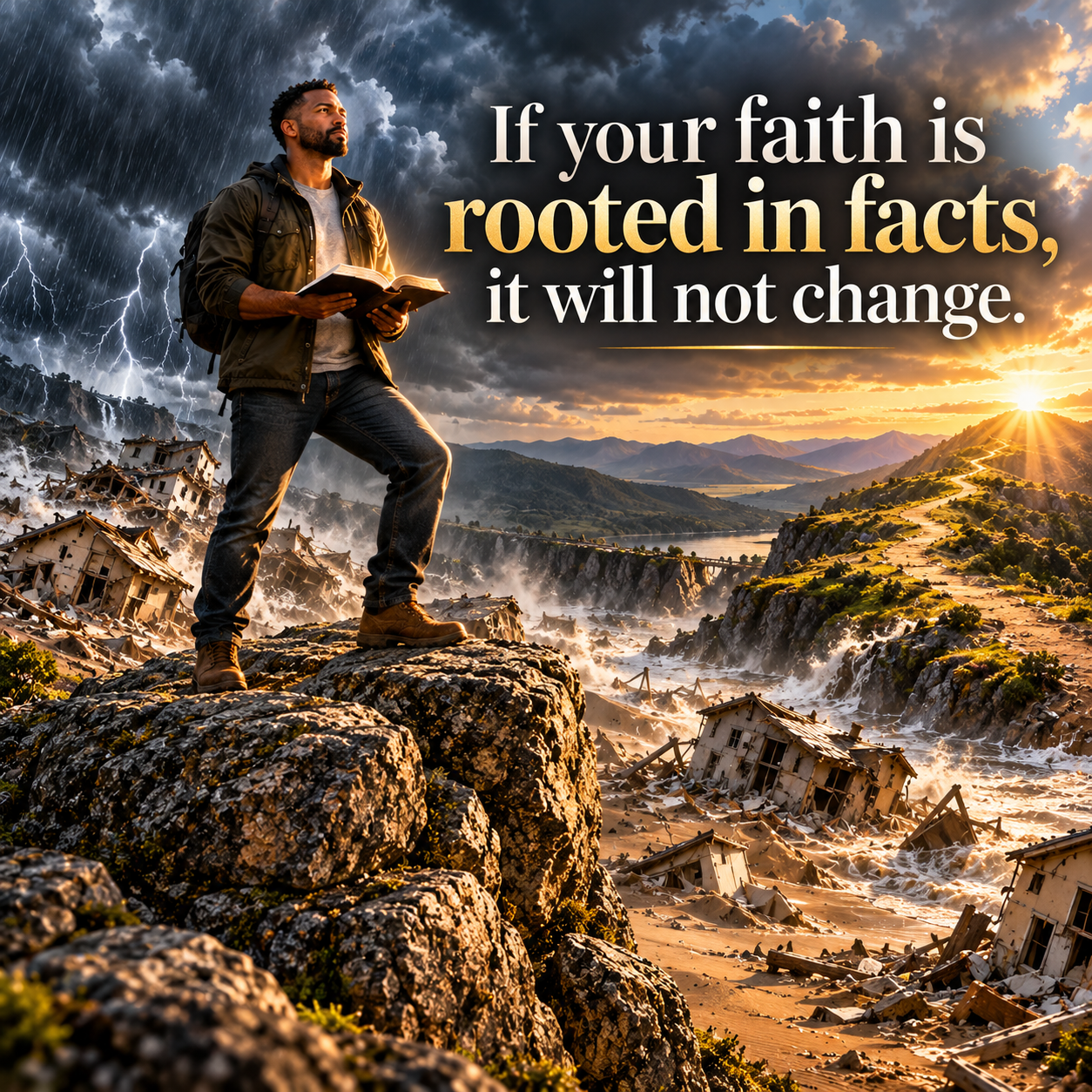
When Truth Is Your Foundation, Every Lie Becomes an Invitation to Examine What You Believe
Shalom mishpacha. Beloved, let us open the Scriptures and allow Yahuah to speak for Himself. Not through the opinions of men, not through inherited traditions, not through religious institutions, and certainly not through feelings that change with every season of life.
Today, we are going to examine something that reaches far deeper than what a person claims to believe. We are going to examine what their belief is actually standing on. Because there is a difference between believing something strongly and believing something because it is true. There is a difference between having faith and simply being convinced. There is a difference between defending what you inherited and standing upon what has been established. And beloved, that distinction matters.
A person can spend forty years believing something and still be wrong. A person can memorize Scripture, attend religious gatherings, defend a doctrine, and teach generations of people without ever examining whether the foundation of that doctrine is actually supported by what is written.
Time does not transform a misunderstanding into truth.
Popularity does not establish righteousness.
Sincerity does not make a falsehood factual.
And repetition does not turn tradition into a commandment from Yahuah.
Let that settle into your heart.
A belief does not become truth because generations have agreed to repeat it.
This is why the foundation matters.
If your faith is built upon emotions, your faith may change when your emotions change.
If your faith is built upon personalities, your faith may collapse when those personalities disappoint you.
If your faith is built upon religious institutions, your confidence may begin to crumble when you discover that those institutions have misrepresented something.
If your faith is built upon inherited interpretations, you may experience a crisis when someone opens the Scriptures and shows you something different.
But when your faith is rooted in what Yahuah has actually established, you do not need to fear investigation.
You do not need to run from difficult passages.
You do not need to silence honest questions.
You do not need to defend a contradiction simply because somebody told you that questioning it demonstrates a lack of faith.
Why?
Because truth does not become false when somebody examines it.
And what Yahuah has established does not become unstable when human understanding is challenged.
However, we must establish something important from the beginning.
Unchanging faith is not the same thing as unchanging human understanding.
A faithful person may discover that something they believed was incorrect. They may need to abandon a tradition, correct an interpretation, or acknowledge that they misunderstood a passage.
That does not necessarily mean their faith has weakened.
Sometimes it means their faith is finally becoming rooted in truth.
The foundation remains while the things improperly built upon it are removed.
And that is where our study begins.
Consider what Yahusha taught concerning foundations.
Mattithyahu (Matthew) 7:24–25
Yahusha describes the person who hears his sayings and does them as a wise man who builds his house upon a rock. Rain falls, floods rise, winds blow, and the house remains standing because its foundation is secure.
Place these supporting witnesses beside that teaching:
Tehillim (Psalms) 18:2 — Yahuah is described as a rock, fortress, and deliverer.
Tehillim (Psalms) 119:89 — The word of Yahuah is settled in heaven.
Yeshayahu (Isaiah) 40:8 — Grass withers and flowers fade, but the word of Elohim stands forever.
Ya’aqob (James) 1:22 — Be doers of the word and not hearers only.
Now notice something.
Yahusha did not say that the wise man built his house upon his feelings about the rock.
He did not say the house survived because the man sincerely believed the foundation was strong.
The foundation was strong, and the man responded correctly by building upon it.
But Yahusha also included obedience.
He who hears and does.
That means genuine faith involves more than possessing accurate information. It requires a response to what has been revealed.
You can understand the existence of a foundation and still refuse to build upon it.
You can recognize the truth and still choose to live contrary to it.
You can quote the Word and still refuse to submit to the One who gave it.
So we must be careful not to reduce faith to intellectual agreement.
Facts reveal the foundation. Faith trusts the One who established it. Obedience demonstrates whether we are actually standing upon it.
And when the storms come, the difference becomes visible.
Beloved, think about how many people have experienced what they called a crisis of faith.
Sometimes that crisis begins when a minister is exposed.
Sometimes it begins when a religious organization is caught in deception.
Sometimes it begins when someone discovers that a familiar teaching is not supported by the passage used to defend it.
Sometimes it begins when a historical claim they have heard their entire life falls apart under examination.
And suddenly, everything they believed feels uncertain.
But we need to ask an uncomfortable question.
Was their confidence rooted in Yahuah?
Or was their confidence rooted in the people who claimed to represent Him?
Those are not the same thing.
Yirmeyahu (Jeremiah) 17:5–8 provides a powerful contrast.
The passage warns against placing ultimate trust in flesh while turning the heart away from Yahuah. It then describes the one who trusts in Yahuah as a tree planted by waters, whose roots remain supplied even when heat and drought arrive.
Beside this passage, consider:
Tehillim (Psalms) 1:1–3 — The person who delights in the Torah of Yahuah is compared to a tree planted by streams of water.
Tehillim (Psalms) 118:8–9 — Trust in Yahuah is better than placing confidence in human beings or rulers.
Mishlei (Proverbs) 3:5–6 — Trust in Yahuah rather than leaning upon your own understanding.
Yeshayahu (Isaiah) 26:3–4 — Steadfast trust is associated with peace, and Yahuah is the everlasting rock.
Do you see the connection?
The tree survives because of where its roots are drawing nourishment.
The stability is not imaginary.
The source is real.
And notice that the heat still comes.
The drought still comes.
The environment still changes.
Being rooted in truth does not mean circumstances will never challenge you.
It means the source sustaining your faith is not dependent upon circumstances remaining comfortable.
When the roots reach the right source, the changing season does not get to dictate whether the tree has life.
Now bring that understanding into the world we are living in.
We have people whose entire belief systems are built upon what they heard from somebody else.
Some inherited their beliefs from parents and grandparents.
Others inherited them from religious institutions.
Others received their understanding from social media teachers, online communities, historical documentaries, or people presenting themselves as authorities on Scripture.
And there is nothing inherently wrong with learning from another person.
Yahuah has always used people to instruct, warn, encourage, and correct.
But there is a difference between receiving instruction and surrendering your ability to examine what you have received.
There is a difference between respecting a teacher and treating a teacher as though their interpretation cannot be questioned.
That brings us to an important example.
Ma’aseh (Acts) 17:10–12
When Paul and Silas came to Berea, the people received the message with readiness while examining the Scriptures daily to determine whether the things being taught were so.
Think about that.
They were listening to Paul.
Yet they still examined the Scriptures.
They did not assume that accepting instruction required abandoning discernment.
They did not treat investigation as disrespect.
And the account describes their conduct favorably.
Now connect the supporting precepts:
Yeshayahu (Isaiah) 8:20 — Teaching and testimony must be measured against what Yahuah has revealed.
Tas’loniqim Aleph (1 Thessalonians) 5:21 — Test all things and hold fast to what is good.
Yochanan Aleph (1 John) 4:1 — Do not believe every spirit; test the spirits because false prophets have gone into the world.
Mishlei (Proverbs) 14:15 — The simple believe every word, but the prudent examine their steps.
Mishlei (Proverbs) 18:17 — The first presentation of a case may appear right until another examines it.
Beloved, these verses expose something that many religious environments have trained people to fear.
Examination.
Some people have been taught that asking questions is rebellion.
Some have been conditioned to believe that requesting scriptural evidence demonstrates spiritual weakness.
Others have been warned that studying outside approved interpretations can lead them away from truth.
But the Bereans demonstrate a different pattern.
They listened.
They examined.
They compared.
They searched.
And their response was not presented as an act of unbelief.
It was presented as noble conduct.
Faith that fears every honest question may be protecting an interpretation rather than trusting the truth.
Now, do not misunderstand that statement.
Not every question is sincere.
Not every accusation is supported.
Not every alternative interpretation is correct.
And the mere existence of doubt does not establish that something is false.
But a teaching does not become sound simply because its supporters discourage scrutiny.
If the claim is that Scripture establishes something, then Scripture should be examined.
If the claim concerns a historical event, then historical evidence should be weighed.
If the claim involves language, then the language should be studied carefully.
And if the claim is based upon tradition, then tradition should not be disguised as a direct commandment.
This is especially important when we consider the difference between faith and evidence.
Ibrim (Hebrews) 11:1 describes faith in relation to things hoped for and things not seen.
Some people interpret this passage as though faith means believing without any reason whatsoever.
Others use it to argue that evidence and faith are opposites.
But examine the wider chapter.
Ibrim (Hebrews) 11:3 connects faith with understanding that the worlds were framed by the word of Elohim.
Ibrim (Hebrews) 11:7 describes Noah responding to a divine warning about events not yet seen.
Ibrim (Hebrews) 11:8 describes Abraham obeying when he was called to depart, although he did not know the destination.
Ibrim (Hebrews) 11:11 associates Sarah’s faith with her judgment that the One who promised was faithful.
Now set beside those:
Bemidbar (Numbers) 23:19 — Elohim does not lie or speak promises He cannot fulfill.
Debarim (Deuteronomy) 7:9 — Yahuah is described as faithful, keeping covenant and steadfast love.
Titus 1:2 — The hope of everlasting life rests upon Elohim, who cannot lie.
Romiyim (Romans) 10:17 — Faith comes through hearing, and hearing through the word concerning Messiah.
Notice the recurring relationship.
Yahuah speaks.
His character is trustworthy.
His promises become the basis for confidence.
And faithful people respond, even when the promised outcome has not yet become visible.
Noah had not seen the approaching judgment unfold, but he acted upon the warning he received.
Abraham had not yet seen the land he was being directed toward, but he obeyed the call.
The unseen future did not require them to pretend they knew everything.
Their confidence was in the trustworthiness of the One who spoke.
That is a crucial distinction.
Faith is not pretending to possess evidence you do not have. Faith is trusting the faithful One concerning what has not yet been seen.
There are promises we await.
There are prophecies whose fulfillment we may not fully understand.
There are events Yahuah has revealed without supplying every detail we might desire.
And there are mysteries about which Scripture gives us boundaries rather than exhaustive explanations.
That is not permission to invent information.
It is an invitation to distinguish what has been revealed from what remains unknown.
Debarim (Deuteronomy) 29:29 establishes that secret things belong to Yahuah, while what has been revealed belongs to His people so they may do the words of His Torah.
Put beside it:
Qorintiyim Aleph (1 Corinthians) 13:12 — Human understanding is presently partial.
Qorintiyim Aleph (1 Corinthians) 8:2 — Those who think they know something must recognize the limits of their knowledge.
Iyob (Job) 38:2–4 — Yahuah challenges Job concerning knowledge of the foundations of creation.
Mishlei (Proverbs) 30:5–6 — Every word of Elohim is refined, and people are warned not to add to His words.
Beloved, this should humble us.
There is a difference between saying, “Yahuah has established this,” and saying, “This is how I currently understand what He has established.”
One acknowledges divine authority.
The other acknowledges human interpretation.
And those two statements must never be carelessly confused.
Why?
Because Yahuah is not obligated to defend every conclusion we have attached to His name.
He is not required to preserve a doctrine merely because we have been teaching it for thirty years.
He is not required to affirm our timeline, our historical theory, our interpretation of prophecy, or our understanding of a difficult passage.
His Word stands.
Our interpretations must remain accountable to it.
The Word does not need to change because our understanding was wrong. Our understanding needs to change because the Word has not.
That brings us to another matter that deserves serious examination.
Many people confuse confidence with correctness.
The louder someone speaks, the more authoritative they appear.
The more verses they quote, the more knowledgeable they seem.
The more complicated their explanation sounds, the more convincing their position becomes.
But a confident presentation is not the same thing as a demonstrated conclusion.
A person can quote ten verses and still misunderstand their context.
A person can offer historical dates and still misrepresent the source.
A person can use Hebrew terminology and still draw conclusions the language does not support.
A person can expose a legitimate deception and then replace it with another unsupported claim.
And a person can become so attached to being right that they no longer recognize when they need correction.
Look at what Scripture says.
Mishlei (Proverbs) 18:13
Answering a matter before hearing it is described as folly and shame.
Place beside it:
Mishlei (Proverbs) 12:15 — The way of a fool seems right in his own eyes, but a wise person listens to counsel.
Mishlei (Proverbs) 19:20 — Listen to counsel and receive instruction so that you may become wise.
Mishlei (Proverbs) 27:6 — Faithful wounds from a friend may be more valuable than deceptive affection.
Ya’aqob (James) 1:19 — Be swift to hear, slow to speak, and slow to anger.
That last verse is especially revealing.
Why would hearing matter?
Because a person who refuses to listen can prevent correction from ever reaching their understanding.
Why should we be slow to speak?
Because a quick answer may reveal more about our pride than our knowledge.
And why should we be slow to anger?
Because anger frequently becomes the shield people raise when evidence threatens something they have become emotionally attached to.
Beloved, there is a kind of religious confidence that is not rooted in faithfulness.
It is rooted in personal identity.
The person no longer simply believes a doctrine.
The doctrine has become part of who they think they are.
And when someone challenges it, they feel as though their entire identity is under attack.
So rather than examine the evidence, they defend the position.
Rather than consider the passage, they attack the person presenting it.
Rather than ask whether the claim is true, they ask who authorized the person to question them.
And the discussion stops being about truth.
It becomes about protecting pride.
When being right becomes more important than finding truth, the heart has already begun defending something other than wisdom.
Now consider a passage that reaches directly into this danger.
Yochanan (John) 8:31–32
Yahusha tells those who believed in him that continuing in his word marks genuine discipleship, and that knowing the truth brings freedom.
Notice the sequence.
Continue in the word.
Become genuine disciples.
Know the truth.
Experience freedom.
He did not teach that freedom comes simply because someone claims membership in a particular group.
He did not say freedom arrives automatically because someone possesses a certain lineage.
He did not suggest that truth becomes irrelevant once a person adopts a religious label.
The emphasis is upon continuing in his word.
Now set these precepts beside the passage:
Yochanan (John) 17:17 — Yahusha identifies the Father’s word as truth.
Tehillim (Psalms) 119:142 — Yahuah’s Torah is truth.
Tehillim (Psalms) 119:151 — All Yahuah’s commandments are truth.
Tehillim (Psalms) 119:160 — The sum of Yahuah’s word is truth, and His righteous judgments endure.
Yochanan Aleph (1 John) 2:4–6 — Claiming to know Him while refusing His commandments exposes a contradiction between confession and conduct.
Do you see what is being established?
Truth is not presented merely as information to collect.
Truth carries an obligation.
It calls for walking.
It calls for remaining.
It calls for obedience.
It calls for a life that agrees with what the mouth professes.
You cannot separate knowing the truth from responding to it and still claim to be walking according to the pattern Yahusha taught.
A man may know the correct Sabbath day and still mistreat his household.
A woman may understand covenant language and still practice deception.
A teacher may accurately explain a prophecy and still be driven by pride.
Someone may correctly identify false religious traditions while continuing in bitterness, envy, hatred, or dishonesty.
Accurate information does not automatically produce a righteous character.
That is why facts matter, but they are not the entirety of faithfulness.
Truth in the mind should become obedience in the walk. Otherwise, knowledge has stopped short of its intended purpose.
Now consider the warning given through the prophet Hoshea.
Hoshua (Hosea) 4:6
The people are described as being destroyed for lack of knowledge, with the passage specifically emphasizing their rejection of knowledge and forgetfulness of the Torah of Elohim.
That context matters.
The prophet is not merely describing people who were never given information.
He is confronting rejection and neglect.
Put these supporting witnesses beside it:
Yeshayahu (Isaiah) 5:13 — The people enter captivity because of a lack of knowledge.
Yirmeyahu (Jeremiah) 8:8–9 — The prophet confronts those who claim wisdom while mishandling the Torah of Yahuah.
Mishlei (Proverbs) 1:7 — The fear of Yahuah is the beginning of knowledge, while fools despise wisdom and instruction.
Mishlei (Proverbs) 1:22–23 — Wisdom calls people to turn from their ways and receive correction.
We must pay attention to the pattern.
Knowledge is connected with instruction.
Instruction is connected with correction.
Correction calls for a response.
And rejection of that knowledge carries consequences.
Here is the uncomfortable question.
What happens when someone finally encounters information that challenges what they were taught?
Do they examine it?
Do they compare it with Scripture?
Do they seek understanding?
Or do they reject it immediately because accepting it would require them to admit they were mistaken?
There are people who say they want truth until truth begins exposing something they love.
They want understanding until understanding requires them to let go of a cherished tradition.
They want restoration until restoration demands repentance.
And they want revelation as long as it never contradicts what their favorite teacher told them.
But truth is not obligated to protect our comfort.
You cannot claim to love the truth while demanding that every discovery agree with what you already believe.
Let us look at the difference between inherited belief and examined conviction.
Yirmeyahu (Jeremiah) 16:19 records the nations acknowledging that their fathers inherited falsehood and worthless things.
That verse should cause every generation to pause.
Because inherited belief is not automatically inherited truth.
But neither is everything inherited automatically false.
The question is whether what we received agrees with what Yahuah has established.
Supporting precepts:
Debarim (Deuteronomy) 4:2 — Do not add to or diminish the commandments given by Yahuah.
Debarim (Deuteronomy) 12:30–32 — Israel is warned against adopting the worship practices of the surrounding nations.
Yirmeyahu (Jeremiah) 10:2–3 — The people are warned not to learn the ways of the nations, whose customs are described as vain.
Marqos (Mark) 7:7–9 — Yahusha confronts the teaching of human commandments as doctrine and the setting aside of Elohim’s commandments in order to maintain tradition.
Consider how easily a belief becomes normal through repetition.
The first generation receives an interpretation.
The second generation grows up hearing it.
The third generation assumes it has always been taught.
By the fourth generation, questioning the interpretation may be treated as questioning Yahuah Himself.
But when did the teaching become divine?
At what point did repetition grant it authority?
Where is the passage establishing that what our ancestors sincerely believed must be preserved even if it contradicts what is written?
There is no such principle.
The obligation is not to defend inherited error.
The obligation is to return to truth.
And let us apply that principle fairly.
It must apply to mainstream religious traditions.
It must also apply to modern restoration movements.
It must apply to claims made by established denominations.
It must also apply to claims made by independent teachers.
It must apply to the historical narratives we inherited.
It must also apply to alternative historical narratives we encounter online.
No community possesses an exemption from examination merely because it claims to be awakening.
No teacher becomes infallible because they expose a real error.
And no movement becomes automatically trustworthy because it opposes another movement.
Leaving one deception does not guarantee you have entered the truth. You must still examine where the new road is leading.
Beloved, that statement is important.
Because sometimes people leave an institution after discovering that they were taught something incorrectly.
That discovery can be painful.
It may involve years of trust.
Family relationships.
Community identity.
Personal sacrifice.
And the realization that something presented as unquestionable was not established as claimed.
But that moment can create another danger.
Someone may become so angry about having been deceived that they accept the next explanation without investigating it.
Why?
Because the new explanation makes them feel awakened.
It provides a sense of belonging.
It offers certainty.
It gives them someone to blame.
It seems to explain everything.
But an emotionally satisfying explanation is not automatically a factual one.
And opposition to an established narrative is not itself evidence that an alternative narrative is correct.
Remember the Bereans.
They did not replace one unquestioned teacher with another.
They examined what was being taught.
The same standard must remain.
Now let us turn to Eph’siyim (Ephesians) 4:11–15.
Paul describes gifts given for the building up of the body, so believers may attain maturity and no longer be like children tossed by waves and carried about by every wind of teaching.
Pay attention to that imagery.
Children tossed back and forth.
Carried by every wind.
Moved by teachings and human craftiness.
Does that not resemble what happens when a person’s beliefs change every time someone presents a convincing video?
One week they embrace one explanation.
The next week they reject it because a new speaker sounds more authoritative.
A month later they adopt another position because someone presents an unfamiliar manuscript, an ancient map, or a Hebrew word they have never studied.
And because they do not possess a disciplined method for testing claims, they mistake constant movement for spiritual growth.
But growth is not measured by how often someone changes positions.
Nor is maturity measured by refusing to change positions.
Maturity is demonstrated through discernment, truthfulness, love, and stability.
Supporting witnesses:
Ibrim (Hebrews) 5:12–14 — Mature believers develop discernment through practice, learning to distinguish good from evil.
Qorintiyim Aleph (1 Corinthians) 14:20 — Do not remain children in understanding; become mature in your thinking.
Ya’aqob (James) 1:5–8 — Seek wisdom from Elohim rather than being divided and unstable.
Yehudah (Jude) 3–4 — Believers are urged to contend for the faith amid the danger of corrupt teaching.
Notice the balance.
Contend for the faith.
But grow in understanding.
Remain established.
But develop discernment.
Hold fast to what is good.
But test what you receive.
That is not instability.
That is faithful examination.
A rooted tree can grow without changing the ground that sustains it.
And beloved, that is the picture we need.
Some people think a stable faith means never having to reconsider anything.
But if Abraham had refused to respond to further instruction because he was satisfied with where he stood, would that have demonstrated faithfulness?
If Peter had insisted that his earlier understanding could never require correction, what would have happened when Yahuah confronted his assumptions?
Look carefully at Ma’aseh (Acts) 10:9–35.
Peter receives a vision and is initially perplexed about its meaning. As the events unfold, he comes to recognize that he should not treat people as common or unclean on the basis of the distinction he had been making.
Peter’s understanding develops.
He does not abandon Yahuah.
He responds to what Yahuah is revealing.
Beside that account:
Ma’aseh (Acts) 11:1–18 — Peter explains the events, and others recognize Yahuah’s work among the nations.
Mishlei (Proverbs) 9:9 — Instruct a wise person, and that person becomes wiser.
Tehillim (Psalms) 25:4–5 — The psalmist asks Yahuah to teach His paths and lead him in truth.
Tehillim (Psalms) 119:18 — The psalmist asks that his eyes be opened to behold wonderful things from the Torah.
Why would a faithful servant ask for his eyes to be opened if he assumed there was nothing more to understand?
Why would he ask to be taught if he believed all his present conclusions were beyond correction?
Because humility recognizes that Yahuah’s truth is greater than our current grasp of it.
A teachable heart is not a weak heart. It is a heart that refuses to place its own understanding above the One who teaches.
Now consider the danger of believing only what we want to hear.
Timotiyos Bet (2 Timothy) 4:3–4
Paul warns that a time will come when people will not endure sound teaching, but will gather teachers to satisfy their own desires and turn away from truth toward myths.
Beside it:
Yeshayahu (Isaiah) 30:9–11 — A rebellious people prefer pleasant messages over truthful correction.
Yirmeyahu (Jeremiah) 6:13–15 — Leaders proclaim peace while failing to address the seriousness of wrongdoing.
Yehezqel (Ezekiel) 13:10 — False assurances of peace are compared to covering an unstable wall.
Galatiyim (Galatians) 4:16 — Paul asks whether he has become an enemy by telling the truth.
This is where the study becomes personal.
Because we often imagine that people reject truth only because they do not have enough information.
But sometimes the information is already in front of them.
The problem is that the conclusion demands something they are unwilling to surrender.
A person may recognize that Scripture calls for repentance, yet continue defending their conduct.
A person may understand that forgiveness is commanded, yet continue nursing bitterness.
A person may know that honest speech is required, yet keep adjusting their testimony to protect their reputation.
A person may see that their favorite teaching has serious problems, yet refuse to examine those problems because doing so might cost them relationships or influence.
At that point, the issue is no longer merely intellectual.
It has become a question of the heart.
Do I want to know what is true?
Or do I want to protect what I prefer?
The most dangerous lie is not always the one someone tells you. Sometimes it is the one you keep repeating because the truth would require you to change.
Now let us examine something else.
If faith is rooted in facts, what kind of facts are we talking about?
That question matters because people often use the word fact loosely.
A fact is not simply a strongly held opinion.
A fact is not an interpretation presented with confidence.
A fact is not a possibility promoted as a certainty.
And a fact is not a historical claim whose evidence has never been checked.
In scriptural study, we should distinguish several things.
What the text actually says.
What its words meant in their linguistic and historical setting.
What the surrounding context supports.
How other passages bear upon the same subject.
What conclusion we draw from those observations.
Those are related, but they are not interchangeable.
Consider a teacher who says, “The Scripture clearly teaches this.”
The appropriate response is not automatically to agree or disagree.
The appropriate response is to examine.
Where is it written?
What does the entire passage say?
Who is speaking?
To whom is the message addressed?
What question is being answered?
What comes before and after?
Are the supporting passages discussing the same matter?
Does the interpretation account for difficult verses, or does it simply ignore them?
And is the proposed conclusion actually established by the text?
This is not unbelief.
It is careful study.
Timotiyos Bet (2 Timothy) 2:15 urges diligent handling of the word of truth.
Beside it:
Nehemyah (Nehemiah) 8:8 — The Torah is read and its meaning explained so that the people understand.
Luqas (Luke) 24:27 — Yahusha explains matters concerning himself from Moses and the Prophets.
Luqas (Luke) 24:44–45 — Yahusha opens the disciples’ understanding concerning the Scriptures.
Ma’aseh (Acts) 18:24–28 — Apollos, knowledgeable in Scripture, receives further instruction and continues teaching.
Notice that scriptural understanding requires care.
It requires explanation.
It requires comparison.
And at times, it requires correction.
A verse taken out of context may still be a genuine verse, but the conclusion attached to it may be false.
A translation may accurately communicate one part of a sentence while obscuring a nuance that requires closer study.
A historical document may genuinely exist while being misquoted or assigned a meaning it cannot support.
And a legitimate pattern in Scripture may still be stretched beyond what the texts establish.
Beloved, we should never fear examining those distinctions.
Because if something is true, faithful examination is its friend.
And if something is false, faithful examination may be the very means by which Yahuah protects us from embracing it.
Now consider the difference between evidence and interpretation in the matter of prophecy.
We have all encountered people who present prophetic timelines with extraordinary confidence.
They announce dates.
They identify modern nations.
They claim that certain events fulfill specific passages.
They connect headlines with ancient visions.
And sometimes they speak as though every detail is beyond dispute.
But what happens when the event does not unfold as predicted?
Do they acknowledge the error?
Or do they modify the timeline and demand that everyone continue believing?
Scripture itself gives us a serious standard concerning claims made in Yahuah’s name.
Debarim (Deuteronomy) 18:20–22 warns against presumptuous prophecy and addresses the significance of a prediction that does not come to pass.
Place beside it:
Yirmeyahu (Jeremiah) 23:16–22 — Yahuah condemns prophets who speak visions from their own hearts rather than His counsel.
Yehezqel (Ezekiel) 13:6–9 — False prophets claim divine authority for visions Yahuah did not send.
Debarim (Deuteronomy) 13:1–4 — Even an impressive sign must not lead people away from faithfulness to Yahuah.
These passages establish an important principle.
Claims of divine authority require discernment.
A prediction’s apparent success is not sufficient if its message directs people away from Yahuah.
And a prediction that fails should not be protected by endless excuses.
The same principle applies to our own interpretations of prophecy.
We must distinguish what the prophecy says from what we think a present event means.
We may identify a possibility.
We may observe a resemblance.
We may find a pattern worth examining.
But possibility is not fulfillment.
Resemblance is not proof.
And confidence is not confirmation.
When Scripture gives us certainty, we should speak with certainty. When Scripture leaves a question open, humility should govern our words.
That is not watering down the faith.
That is refusing to add our assumptions to the Word.
Now let us examine another foundation: the faithfulness of Yahuah Himself.
Malaki (Malachi) 3:6
Yahuah declares that He does not change, in a context concerning His covenant faithfulness and Israel’s continued existence.
Beside this:
Bemidbar (Numbers) 23:19 — Elohim is not like a man who lies or changes His declared purpose through deceit.
Ya’aqob (James) 1:17 — The Father of lights is described as having no variation or shifting shadow.
Tehillim (Psalms) 33:11 — The counsel of Yahuah stands forever, and His purposes endure through generations.
Yeshayahu (Isaiah) 46:9–10 — Yahuah declares His uniqueness and the endurance of His counsel.
These passages give us a foundation greater than human certainty.
His character.
His faithfulness.
His truthfulness.
His ability to accomplish what He has promised.
Now compare that with human nature.
We forget.
We misunderstand.
We change our minds.
We make assumptions.
We become influenced by culture.
We are vulnerable to pride.
We often interpret new information through familiar expectations.
And even when our intentions are sincere, our conclusions may be incomplete.
That is why our faith must never rest upon the fantasy that we are incapable of error.
Our confidence must rest upon the One who is faithful.
The strength of your faith is not proven by how loudly you insist you cannot be wrong. It is revealed by how faithfully you respond when Yahuah’s truth corrects you.
Now let us look at Yahusha’s own example in confronting religious tradition.
In Marqos (Mark) 7:6–13, he rebukes religious leaders for honoring Elohim with their lips while allowing traditions to undermine the commandments.
The issue was not merely that the leaders possessed inherited customs.
The issue was that human tradition had been given authority that interfered with divine instruction.
Now place beside this:
Yeshayahu (Isaiah) 29:13 — The people draw near with their lips while their hearts remain far away, and their reverence becomes shaped by human instruction.
Debarim (Deuteronomy) 4:2 — Do not add to or take away from the commandments.
Qoheleth (Ecclesiastes) 12:13 — Fear Elohim and keep His commandments.
Yochanan (John) 14:15 — Yahusha connects love for him with keeping his commandments.
Consider the challenge here.
Those leaders were not necessarily lacking religious commitment.
They had customs.
They had systems.
They had public authority.
They possessed knowledge of religious practices.
Yet Yahusha challenged the relationship between those practices and what Yahuah had commanded.
That should make every sincere student of Scripture cautious.
Because outward religious seriousness is not automatic evidence of faithfulness.
A person can be deeply committed to a system that needs correction.
The question is not simply whether we are devoted.
The question is what we are devoted to.
You can be loyal to a religious system and still be unfaithful to the truth that system claims to represent.
This brings us to a difficult but necessary heart-check.
What would happen if tomorrow someone showed you, through a careful reading of Scripture, that a belief you have defended for years was mistaken?
Would you examine it?
Would you receive correction if the evidence warranted it?
Or would you immediately search for a way to dismiss the person presenting it?
Suppose a teaching has become part of your identity.
You have shared it publicly.
You have persuaded family members.
You have challenged others.
You have built an entire series of studies around it.
Then a previously overlooked passage, historical source, or linguistic detail raises a serious problem.
What happens next?
This is where humility must become more valuable than reputation.
Mishlei (Proverbs) 15:31–33 connects listening to life-giving correction with dwelling among the wise and receiving understanding.
Beside it:
Mishlei (Proverbs) 10:17 — Whoever accepts instruction remains on the path of life, while rejecting correction leads astray.
Mishlei (Proverbs) 13:18 — Poverty and shame come to those who disregard discipline, while honor accompanies those who heed correction.
Mishlei (Proverbs) 28:13 — Concealing wrongdoing prevents flourishing, while confession and forsaking it lead toward mercy.
Ya’aqob (James) 3:13–17 — Wisdom from above is characterized by purity, peace, gentleness, reasonableness, mercy, and good fruit.
Notice that heavenly wisdom is not characterized by stubborn defensiveness.
It is not built upon the need to win every argument.
It does not require someone to misrepresent evidence to preserve personal authority.
And it does not treat acknowledging error as humiliation.
A wise person can say, “I was wrong.”
A faithful teacher can say, “I need to revisit that passage.”
A sincere believer can say, “I once understood this differently, but further examination has changed my understanding.”
Those statements do not diminish the authority of Yahuah.
They acknowledge the limitations of the human being studying His Word.
The truth did not lose its authority because you corrected your understanding of it.
Beloved, we also need to talk about what happens when life itself begins testing our faith.
It is one thing to speak confidently when everything appears peaceful.
It is another thing to remain faithful when obedience becomes costly.
Some people’s faith appears strong as long as Yahuah gives them what they want.
They trust while doors are opening.
They rejoice while relationships are flourishing.
They testify while finances are comfortable.
They proclaim confidence while their expectations are being met.
But what happens when circumstances change?
What happens when the prayer is not answered according to their preferred timeline?
What happens when people abandon them?
What happens when faithfulness requires sacrifice?
What happens when they experience suffering they cannot fully explain?
Does the foundation remain?
Consider Habaqquq (Habakkuk) 3:17–19.
The prophet describes devastating agricultural failure and loss, yet declares his intention to rejoice in Yahuah.
Now place beside it:
Iyob (Job) 1:20–22 — Job worships amid tremendous loss rather than immediately accusing Elohim of wrongdoing.
Iyob (Job) 13:15 — Job expresses a determination to maintain his case before Elohim even in the face of mortal danger.
Romiyim (Romans) 8:35–39 — Paul describes suffering and hardship while affirming that they cannot separate believers from the love of Elohim in Messiah.
Ya’aqob (James) 1:2–4 — Testing can produce endurance and maturity.
What do these witnesses show us?
Faith is not established by favorable circumstances.
The faithfulness of Yahuah does not cease merely because life becomes painful.
But we should not pretend these passages eliminate grief, confusion, or the need to lament.
Job grieved.
The prophets lamented.
The psalmists cried out.
Yahusha himself experienced anguish.
Steadfast faith is not emotional numbness.
A person can weep and remain faithful.
A person can ask sincere questions and remain faithful.
A person can admit that they do not understand a painful experience and remain faithful.
The foundation is not proven by pretending there is no storm.
It is proven when the storm fails to become the authority by which everything else is judged.
A faith built only upon favorable outcomes will eventually face a season it cannot explain. A faith rooted in Yahuah’s faithfulness has somewhere to stand even then.
Now let us examine the ultimate expression of faith that is rooted in truth rather than human approval.
Galatiyim (Galatians) 1:10
Paul asks whether he is seeking the approval of people or of Elohim, and indicates that serving Messiah cannot be governed by the desire to please human beings.
Beside it:
Shemoth (Exodus) 23:2 — Do not follow a multitude in doing wrong.
Yochanan (John) 12:42–43 — Some authorities feared openly confessing their belief because they loved human praise.
Ma’aseh (Acts) 5:29 — The apostles declare that obedience to Elohim takes precedence over obedience to men.
Mishlei (Proverbs) 29:25 — The fear of man creates a snare, while trust in Yahuah provides security.
Beloved, this is where facts and faithfulness meet courage.
Because recognizing the truth is one matter.
Standing upon it when the crowd disagrees is another.
There will be times when you may discover something in Scripture that challenges what people around you believe.
And you may feel pressure.
Pressure to remain quiet.
Pressure to agree.
Pressure to avoid difficult conversations.
Pressure to protect relationships by pretending you see no problem.
But there is also another danger.
The desire to appear different can become its own form of seeking human approval.
Some people reject the majority position simply because they enjoy being part of a minority.
They confuse opposition with righteousness.
They imagine that being criticized automatically proves they are correct.
But Scripture does not teach that every unpopular opinion is true.
Nor does it teach that every widely accepted conclusion is false.
Truth is not determined by the size of the crowd on either side.
A thousand people agreeing cannot make a lie true. And one person disagreeing cannot make that person right.
The question remains: What has been established?
What is the evidence?
What does Scripture actually say?
And what response does faithfulness require?
Now let us return to the title of our study.
If your faith is rooted in facts, it will not change.
We need to understand that statement carefully.
If by faith we mean trust in Yahuah’s faithful character and commitment to the truth He has revealed, then that trust can remain steadfast through seasons of discovery, hardship, and correction.
But if by faith we mean every interpretation, assumption, historical conclusion, and doctrinal formulation we presently hold, then those things must remain open to examination.
We should never promise to preserve an error simply to demonstrate consistency.
And we should never demand that the Father protect our misunderstandings from correction.
That would make our own minds the final authority.
This is why Tehillim (Psalms) 119:105 describes the Word as a lamp to the feet and a light to the path.
Beside it:
Tehillim (Psalms) 119:130 — The opening of Yahuah’s words gives light and understanding.
Mishlei (Proverbs) 6:23 — The commandment is a lamp, the Torah is light, and corrective instruction is the way of life.
Kepha Bet (2 Peter) 1:19 — The prophetic word is compared to a lamp shining in a dark place.
Yochanan (John) 8:12 — Yahusha identifies himself as the light of the world and calls people to follow him rather than walk in darkness.
What does light do?
It reveals what is already there.
It exposes obstacles.
It makes the path visible.
It allows someone to see what darkness previously concealed.
But consider this.
When light reveals that you have been walking in the wrong direction, what should you do?
Continue walking because you have already traveled so far?
Defend the road because your family walked it before you?
Insist the light must be mistaken because you have invested years in the journey?
Or change direction?
That is the beauty of repentance.
Repentance recognizes the need to turn.
And turning toward truth is not betrayal of faith.
It is an expression of faithfulness.
The distance you have traveled in the wrong direction is never a reason to reject the light that shows you the way back.
Beloved, perhaps that is the word someone needs today.
You do not have to defend everything you were taught.
You do not have to pretend every teacher you respected was correct.
You do not have to preserve a doctrine because your reputation is attached to it.
You do not have to accept every alternative explanation merely because it challenges a tradition you left behind.
And you do not have to fear saying, “I need to study that more.”
There is strength in patience.
There is wisdom in investigation.
There is humility in correction.
And there is freedom in refusing to confuse your personal conclusions with Yahuah’s eternal truth.
The truth is not threatened when a lie is exposed. Only the lie is threatened.
But there is one more matter we cannot leave untouched.
Facts alone do not guarantee transformation.
A person may accumulate an extraordinary amount of scriptural knowledge while remaining spiritually resistant.
They may know the names of ancient cities, the genealogies of kings, the historical setting of the prophets, and the meaning of numerous Hebrew terms.
They may identify translation problems, compare manuscripts, and expose false quotations.
Yet if that knowledge does not produce humility, righteousness, mercy, love, and obedience, something essential is missing.
Consider Qorintiyim Aleph (1 Corinthians) 8:1–3.
Paul warns that knowledge can become a source of arrogance, while love builds up.
Beside it:
Ya’aqob (James) 2:17–18 — Faith without corresponding works is dead.
Galatiyim (Galatians) 5:22–23 — The fruit of the Spirit includes love, joy, peace, patience, kindness, goodness, faithfulness, gentleness, and self-control.
Kepha Bet (2 Peter) 1:5–8 — Faith is to be accompanied by virtue, knowledge, self-control, perseverance, reverence, brotherly affection, and love.
Yochanan Aleph (1 John) 3:18 — Love must be expressed through genuine action, not words alone.
This brings us back to the beginning.
The wise man did not merely hear.
He did.
Faithfulness is not demonstrated simply by knowing the correct answer.
It is demonstrated when truth governs our decisions, our speech, our relationships, and our conduct.
If I know that Yahuah commands honesty but knowingly spread false information, what good is my claim to love facts?
If I say I am committed to Scripture but refuse to correct a false statement once I know it is false, what am I demonstrating?
If I demand historical evidence from those who disagree with me while accepting unsupported claims from those who agree with me, am I really committed to truth?
If I condemn tradition for adding to Scripture while adding my own assumptions to Scripture, what have I learned?
These are questions every one of us must be willing to ask.
Because truth must not become a weapon we use against others while refusing to allow it to examine us.
A person who uses truth only to expose others has not yet allowed truth to finish its work in their own heart.
And that is where the final test begins.
Not merely with what we say.
Not merely with what we know.
But with what our lives reveal.
Yahusha declared in Mattithyahu (Matthew) 7:16–20 that trees are recognized by their fruit.
Beside this:
Luqas (Luke) 6:43–45 — The fruit of a tree reflects its condition, and the mouth speaks from the abundance of the heart.
Yochanan (John) 15:4–8 — Abiding in Yahusha is associated with bearing fruit.
Tehillim (Psalms) 1:2–3 — The one rooted in Yahuah’s instruction bears fruit in season.
Ya’aqob (James) 3:17–18 — Wisdom from above produces peaceable and righteous fruit.
A tree may survive the storm.
But its fruit will still reveal something about its health.
Likewise, a person may defend sound doctrine while demonstrating a spirit that contradicts what they profess.
That does not make truth false.
It reveals that the person has not fully submitted to the truth they claim to possess.
And beloved, we should never confuse those two things.
The failures of a teacher do not automatically disprove everything they taught.
The hypocrisy of an institution does not automatically make every claim it has ever made false.
And the misconduct of someone who professes faith does not establish that Yahuah is unfaithful.
Human beings must be examined according to their conduct.
Teachings must be examined according to their evidence and their faithfulness to Scripture.
Yahuah’s character must not be reduced to the failures of those who claim to represent Him.
When we keep those distinctions clear, disappointment does not have to become spiritual collapse.
When a teacher falls, examine the teacher.
When a doctrine fails, examine the doctrine.
When a historical claim is disproved, correct the claim.
But do not confuse the collapse of an unsupported belief with the collapse of truth itself.
The fall of a man does not mean the Word has fallen with him.
So here is the invitation.
Let the Word examine what you believe.
Let the evidence test what you have been told.
Let context correct careless interpretations.
Let history be examined honestly, without requiring it to support a predetermined conclusion.
Let correction produce humility instead of anger.
Let obedience demonstrate what your lips profess.
And let your trust remain anchored in the faithfulness of Yahuah rather than the perfection of your own understanding.
We are not called to be people who cannot be corrected.
We are called to be people who refuse to exchange truth for convenience.
We are not called to have an answer for every mystery.
We are called to be faithful with what has been revealed.
We are not called to defend every conclusion we have ever reached.
We are called to walk in the light that Yahuah provides.
And as we grow, some understandings will deepen.
Some assumptions will fall away.
Some interpretations may require correction.
Some long-held traditions may need to be abandoned.
But none of that requires us to abandon the One whose Word brought the correction.
That is the difference between faith rooted in human certainty and faith rooted in divine faithfulness.
One is threatened whenever its conclusions are questioned.
The other is willing to be examined because its highest loyalty is to the truth.
One says, “I refuse to change because I cannot be wrong.”
The other says, “I will not abandon the truth, even when the truth requires me to admit I was wrong.”
And beloved, those are two very different foundations.
Remember the words of Tehillim (Psalms) 25:4–5:
The psalmist asks Yahuah to make His ways known, teach His paths, and lead him in truth.
That is the posture we should carry.
Teach me.
Lead me.
Correct me.
Establish me.
Not according to my pride.
Not according to what makes me popular.
Not according to the religious traditions I inherited.
Not according to whatever explanation is circulating today.
But according to what You have established.
Because the goal is not to be the person who never changed an opinion. The goal is to be the person who never stopped pursuing the truth.
And when truth becomes more important than being right, wisdom has room to grow.
When obedience becomes more important than appearances, faith begins to produce fruit.
When Yahuah becomes greater than the teachers who speak about Him, the foundation becomes clearer.
And when His Word becomes the standard by which every claim is examined, deception loses one of its greatest advantages: our unwillingness to question what we already believe.
So let this be the final heart-check.
If the facts support what you believe, do not be afraid to examine them.
If the facts challenge what you believe, do not be afraid to learn from them.
If Scripture corrects your understanding, do not be ashamed to receive that correction.
And if the world around you changes, remember that the faithfulness of Yahuah does not depend upon the instability of the world.
Faith rooted in Yahuah’s truth does not have to change with every passing wind. But a faithful heart must always be willing to change when it discovers it has mistaken a human opinion for the truth.
That is not compromise.
That is not weakness.
That is not abandoning the Way.
That is how we keep returning to it.
Closing Prayer
Abba Yahuah, our Father, we come before You with humbled hearts, asking that You establish us in truth.
Remove from us the pride that causes us to defend error. Remove the fear that causes us to avoid examination. Remove the desire for human approval that tempts us to compromise what You have commanded.
Father, teach us to distinguish Your Word from the interpretations of men. Give us wisdom to examine what we hear, patience to study what we do not yet understand, and courage to correct what we discover to be wrong.
Let us never become so attached to a teacher, institution, tradition, or personal conclusion that we refuse the correction of Your Word.
Guard us from deception, including the deception we may unknowingly practice against ourselves.
Give us hearts that love truth more than recognition, obedience more than appearance, and righteousness more than winning arguments.
Strengthen us when circumstances change. Sustain us when life becomes difficult. Teach us to trust Your faithfulness even when we cannot see the outcome.
May our knowledge produce humility.
May our faith produce endurance.
May our obedience produce good fruit.
And may our lives reflect the truth we profess.
Lead us in the ancient paths of righteousness, according to Your Word, through the instruction and example of Yahusha, Your Son.
Amein.


Leave a Reply