- If Jesus Is Not God, Who Is He?
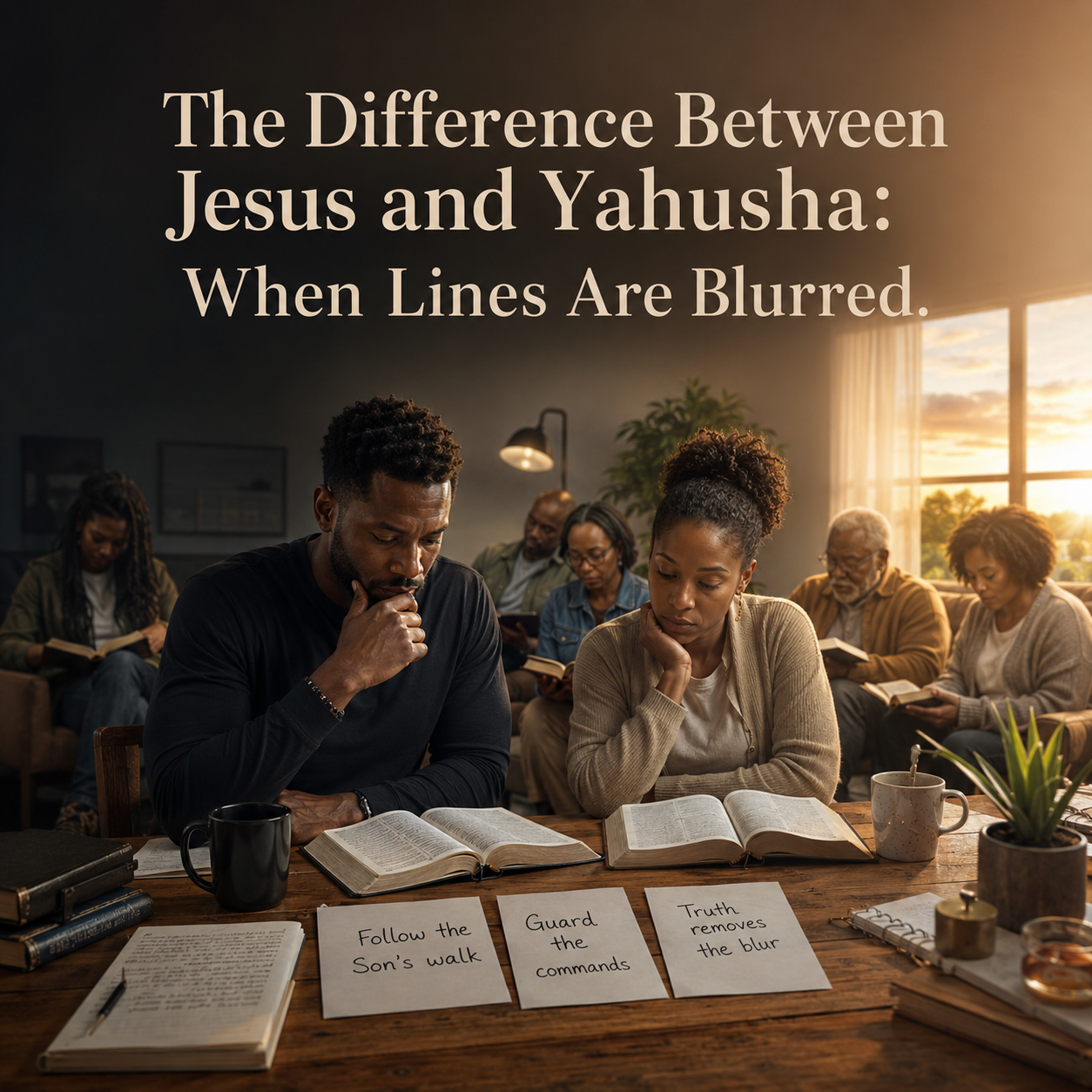
- The Difference Between Jesus and Yahusha: When Lines Are Blurred
Shalom mishpacha. Today we are walking into a study that may sound simple on the surface, but it cuts deep when we slow down and let Scripture speak for itself. Because this is not just about pronunciation. This is not just about language. This is not just about whether somebody says “Jesus,” “Yeshua,” “Yahshua,” or “Yahusha.” The deeper question is this: Are we following the Son sent by Yahuah, or are we following a religious image that has been blurred by tradition, culture, and lawlessness?
That is where the line gets serious.
Because a name is never just a sound in Scripture. A name carries authority, identity, mission, character, and ownership. When Yahuah reveals His Name, He is not just giving people syllables; He is revealing who He is, what He does, and who His people belong to.
Shemoth (Exodus) 3:15 — “This is My Name forever, and this is My remembrance to all generations.”
Tehillim (Psalms) 83:18 — “That they may know that You, whose Name alone is Yahuah, are the Most High over all the earth.”
Yeshayahu (Isaiah) 42:8 — “I am Yahuah, that is My Name, and My esteem I do not give to another.”
Mishlei (Proverbs) 30:4 — “What is His Name, and what is His Son’s Name, if you know?”
That question in Mishlei (Proverbs) hits like a blade: What is His Name, and what is His Son’s Name? Scripture is already warning us that the Name of the Father and the Name of the Son matter. And if the Father’s Name matters, then the Son’s Name cannot be treated like a small thing.
But let’s be clear from the beginning: this study is not about mocking people who only know the name “Jesus.” Many of us came through that name because that is what we were taught. Many of us prayed, cried, repented, searched, and called out according to the light we had. Yahuah is merciful. He knows the ignorance we were born into, the traditions we inherited, and the systems that trained us.
Ma’aseh (Acts) 17:30 — “Truly, then, having overlooked these times of ignorance, now commands all men everywhere to repent.”
But once light comes, responsibility comes with it.
That is the part many people resist.
A person can be sincere in ignorance, but once truth comes, sincerity is no longer a hiding place.
So this study is not about attacking the ignorant. It is about exposing the blur. It is about asking whether the figure called “Jesus” in popular religion still resembles the Yahusha of Scripture, or whether centuries of tradition have dressed Him in garments He never wore, attached doctrines He never taught, separated Him from the Father’s commandments, and made Him the mascot of lawlessness.
Because the danger is not simply saying a different sound. The danger is following a different image.
Sha’ul (Paul) warned about this.
Qorintiyim Bet (2 Corinthians) 11:3-4 — “But I am afraid, lest, as the serpent deceived Hawwah (Eve) by his trickery, so your minds should be corrupted from the simplicity that is in Mashiach (Messiah). For, indeed, if he who is coming proclaims another Yahusha, whom we have not proclaimed, or if you receive a different spirit which you have not received, or a different good news which you have not accepted, you put up with it well enough.”
That is heavy. There can be “another” version presented. Another spirit. Another good news. Another image. Another message. Another path. Another personality. Another “Christ” that people accept because it sounds religious, but the fruit leads them away from obedience.
And this is where the blurred line becomes dangerous.
The Yahusha of Scripture did not come to erase His Father’s Word. He came walking as the living example of it.
Mattithyahu (Matthew) 5:17-19 — “Do not think that I came to destroy the Torah or the Prophets. I did not come to destroy but to complete. For truly, I say to you, till the heaven and the earth pass away, one yod or one tittle shall by no means pass from the Torah till all be done. Whoever, then, breaks one of the least of these commands, and teaches men so, shall be called least in the reign of the heavens.”
Yochanan (John) 15:10 — “If you guard My commands, you shall stay in My love, even as I have guarded My Father’s commands and stay in His love.”
Yahuchanan Aleph (1 John) 2:6 — “The one who says he stays in Him ought himself also to walk, even as He walked.”
This is where the difference begins to show itself plainly.
The “Jesus” of mainstream religious imagination is often presented as the one who came to free people from obedience. But Yahusha of Scripture said He did not come to destroy the Torah. The “Jesus” of tradition is often used to make the commandments feel optional. But Yahusha said if you love Me, guard My commands.
Yochanan (John) 14:15 — “If you love Me, you shall guard My commands.”
Yochanan (John) 14:21 — “He who possesses My commands and guards them, it is he who loves Me.”
Yochanan (John) 14:24 — “He who does not love Me does not guard My Words.”
So we have to ask honestly: if the version of the Son someone gave us trains us to despise the Father’s commandments, is that Yahusha? Or is that a blurred image?
Because Yahusha never taught rebellion dressed as grace. Yahusha never taught faith without obedience. Yahusha never taught love without commandments. Yahusha never taught salvation without repentance. Yahusha never taught a kingdom without covenant.
The world made obedience sound like bondage because lawlessness needed a religious costume.
Let’s go line upon line.
The Son did not come in His own name, His own authority, or His own doctrine. He came representing the Father.
Yochanan (John) 5:43 — “I have come in My Father’s Name, and you do not receive Me.”
Yochanan (John) 7:16 — “My teaching is not Mine, but His who sent Me.”
Yochanan (John) 8:28 — “I do none at all of Myself, but as My Father taught Me, these words I speak.”
Yochanan (John) 12:49-50 — “Because I spoke not from Myself, but the Father who sent Me has given Me a command, what I should say and what I should speak.”
Yochanan (John) 17:6 — “I have revealed Your Name to the men whom You gave Me out of the world.”
Now pause there.
Yahusha said He revealed the Father’s Name. He came in His Father’s Name. He spoke His Father’s words. He obeyed His Father’s commands. He did His Father’s will. He pointed people back to the Father.
So any version of the Son that hides the Father’s Name, replaces the Father’s commands, and teaches people that obedience is no longer required is not standing in the same testimony.
That is not a small blur. That is a different road.
Yahusha did not come to make the Father unknown; He came to make the Father known.
Yochanan (John) 17:26 — “And I have made Your Name known to them, and shall make it known.”
Ibrim (Hebrews) 2:12 — “I shall announce Your Name to My brothers, in the midst of the assembly I shall sing praise to You.”
Tehillim (Psalms) 22:22 — “I make known Your Name to My brothers; in the midst of the assembly I praise You.”
That means the Son’s mission includes revealing the Father’s Name. Not concealing it. Not replacing it. Not removing it from remembrance. Not making the Father generic.
And this is one of the greatest blurs in modern religion: the Father becomes “God,” the Son becomes “Jesus,” and the covenant identity gets buried under titles. But Scripture does not move like that. Scripture reveals names, covenants, people, commandments, promises, land, exile, regathering, repentance, and restoration.
When we flatten all of that into generic religion, we lose the path.
A generic god can fit any religion, but Yahuah calls His people by covenant.
Shemoth (Exodus) 6:6-7 — “I am Yahuah, and I shall bring you out from under the burdens of the Mitsrites… and I shall take you as My people, and I shall be your Elohim.”
Wayyiqra (Leviticus) 22:31-33 — “And you shall guard My commands and do them. I am Yahuah. And do not profane My set-apart Name… I am Yahuah who sets you apart, who brought you out of the land of Mitsrayim.”
Yehezqel (Ezekiel) 36:22-23 — “I do not do this for your sake, O house of Yisrael, but for My set-apart Name’s sake… and I shall set apart My great Name, which has been profaned among the nations.”
Yahuah ties His Name to His people, His deliverance, His commandments, and His reputation among the nations. So when the Son comes in the Father’s Name, He is not coming disconnected from that story. Yahusha is not a new religion. Yahusha is the Son sent into the covenant story Yahuah had already spoken through the Torah and the Prophets.
That is why He said:
Mattithyahu (Matthew) 15:24 — “I was not sent except to the lost sheep of the house of Yisrael.”
That one verse shatters a lot of religious fog. Yahusha’s mission is not floating in a vacuum. It is tied to the promises, the covenant, and the lost sheep. He did not come starting a religion that erases Yisrael. He came as the promised Shepherd, gathering what was scattered.
Yehezqel (Ezekiel) 34:11-13 — “See, I Myself shall search for My sheep and seek them out… and I shall deliver them from all the places where they were scattered.”
Yirmeyahu (Jeremiah) 23:3-5 — “Therefore I shall gather the remnant of My flock out of all lands where I have driven them… See, the days are coming, declares Yahuah, when I shall raise for Dawid a Branch of righteousness.”
Yochanan (John) 10:14-16 — “I am the good shepherd… and other sheep I have which are not of this fold; I have to bring them as well.”
So when people preach a “Jesus” who is detached from the regathering of Yisrael, detached from Torah, detached from repentance, detached from covenant, and detached from the Father’s Name, we need to ask: who is that?
Because Yahusha stands inside the promises of Yahuah. He does not erase them.
The true Son does not pull you away from the Father’s Word; He leads you back to it.
Now let’s talk about the name itself without turning this into a fight over letters only.
The name commonly spoken as “Jesus” came into English through language development and translation history. Many people inherited it without malicious intent. But the issue is not only whether a person grew up saying “Jesus.” The issue is what has been attached to that name in mainstream religion.
Because in Scripture, the Son’s identity is inseparable from salvation, deliverance, and the Name of Yahuah. The name Yahusha carries the meaning of Yahuah’s deliverance, Yahuah saves, Yahuah is salvation. That is not cosmetic. That is covenant meaning.
Mattithyahu (Matthew) 1:21 — “And she shall give birth to a Son, and you shall call His Name Yahusha, for He shall save His people from their sins.”
His Name is tied to His mission: saving His people from their sins.
Not saving them in their sins.
Not excusing rebellion.
Not calling lawlessness freedom.
Not giving religious comfort while the heart remains uncircumcised.
He saves His people from their sins.
And Scripture defines sin.
Yahuchanan Aleph (1 John) 3:4 — “Everyone doing sin also does lawlessness, and sin is lawlessness.”
Romiyim (Romans) 7:7 — “What, then, shall we say? Is the Torah sin? Let it not be! However, I did not know sin except through the Torah.”
Tehillim (Psalms) 119:11 — “I have treasured up Your Word in my heart, that I might not sin against You.”
So if Yahusha saves His people from sin, and sin is lawlessness, then Yahusha saves His people from lawlessness.
That means any version of “Jesus” that teaches people to remain lawless while claiming salvation is contradicting the mission of Yahusha.
He did not come to save us from obedience; He came to save us from rebellion.
That line must be clear.
Titus 2:11-14 — “For the saving gift of Elohim has appeared to all men, instructing us to renounce wickedness and worldly lusts… who gave Himself for us, to redeem us from all lawlessness and to cleanse for Himself a people, His own possession, ardent for good works.”
Mattithyahu (Matthew) 7:21-23 — “Not everyone who says to Me, ‘Master, Master,’ shall enter into the reign of the heavens… And then I shall declare to them, ‘I never knew you, depart from Me, you who work lawlessness.’”
That passage should shake every religious room.
These are not atheists. These are people calling Him “Master.” These are people claiming spiritual works. They prophesied. They cast out demons. They did mighty works. But Yahusha says, “Depart from Me, you who work lawlessness.”
So the problem is not that they lacked religious vocabulary. The problem is that their walk was lawless.
Religious words cannot cover a rebellious walk.
And this is where “Jesus” and Yahusha get blurred in the minds of many. The religious image says, “Just believe, and obedience is extra.” Yahusha says, “Why do you call Me Master, Master, and do not do what I say?”
Luqas (Luke) 6:46 — “But why do you call Me ‘Master, Master,’ and do not do what I say?”
Yaaqob (James) 1:22 — “And become doers of the Word, and not hearers only, deceiving yourselves.”
Yaaqob (James) 2:17 — “So also belief, if it does not have works, is in itself dead.”
Yahuchanan Aleph (1 John) 2:3-4 — “And by this we know that we know Him, if we guard His commands. The one who says, ‘I know Him,’ and does not guard His commands, is a liar, and the truth is not in him.”
That is not complicated. Religion makes it complicated because lawlessness needs room to breathe. But Scripture is sharp. Knowing Him is proven by guarding His commands.
So when someone says, “I know Jesus,” but they reject the walk of Yahusha, Scripture says we must test that claim.
Not by feelings.
Not by church attendance.
Not by emotional music.
Not by religious phrases.
By fruit. By obedience. By the Word.
Mattithyahu (Matthew) 7:16 — “By their fruits you shall know them.”
Yeshayahu (Isaiah) 8:20 — “To the Torah and to the witness! If they do not speak according to this Word, it is because they have no daybreak.”
Hitgalut (Revelation) 12:17 — “The dragon was enraged with the woman, and he went to fight with the remnant of her seed, those guarding the commands of Yahuah and possessing the witness of Yahusha Messiah.”
Hitgalut (Revelation) 14:12 — “Here is the endurance of the set-apart ones, here are those guarding the commands of Yahuah and the belief of Yahusha.”
Notice the end-time people. They are not described as people who choose between commandments and Yahusha. They have both. They guard the commands of Yahuah and hold the belief/witness of Yahusha.
That is the covenant balance.
The false image separates what Scripture joins together.
It says, “Take Jesus, but leave Torah.”
It says, “Take grace, but leave obedience.”
It says, “Take salvation, but leave repentance.”
It says, “Take the Savior, but forget the Father’s Name.”
But Scripture says the remnant has the commands of Yahuah and the testimony of Yahusha.
The remnant does not choose between the Father and the Son. The remnant follows the Son back to the Father.
Now let’s deal with another blurred line: image.
For many people, “Jesus” is not just a name; it is an inherited cultural image. Often it is an image shaped by empire, paintings, denominational traditions, holidays, icons, and European religious imagination. But Yahusha was not born into Rome’s religion. He was born under the covenant story of Yisrael. He walked among a people with Torah, Prophets, Sabbaths, feasts, clean and unclean distinctions, circumcision, temple language, exile expectation, and messianic hope.
Luqas (Luke) 2:21-22 — “And when eight days were completed for Him to be circumcised, His Name was called Yahusha… and when the days of her cleansing according to the Torah of Mosheh were completed…”
Luqas (Luke) 4:16 — “And He came to Natsareth, where He had been brought up. And according to His practice, He went into the congregation on the Sabbath day, and stood up to read.”
Yochanan (John) 7:16-17 — “My teaching is not Mine, but His who sent Me. If anyone desires to do His desire, he shall know concerning the teaching.”
Luqas (Luke) 24:44 — “These are the words which I spoke to you while I was still with you, that all have to be filled that were written in the Torah of Mosheh and the Prophets and the Psalms concerning Me.”
Yahusha is revealed through Torah, Prophets, and Psalms. Not through later religious imagination. Not through replacement theology. Not through Greco-Roman filters. Not through lawless grace. Not through images that detach Him from Yahuah’s covenant.
He is the promised Son, the suffering servant, the Branch, the Prophet like Mosheh, the Shepherd, the Lamb, the King, the Word made flesh, the one who obeys the Father perfectly.
Debarim (Deuteronomy) 18:18-19 — “I shall raise up for them a Prophet like you out of the midst of their brothers… and I shall put My Words in His mouth.”
Yeshayahu (Isaiah) 53:6 — “Yahuah has laid on Him the crookedness of us all.”
Yirmeyahu (Jeremiah) 23:5 — “I shall raise for Dawid a Branch of righteousness, and He shall reign as sovereign and act wisely.”
Mikah (Micah) 5:2 — “Out of you shall come forth to Me the One to become Ruler in Yisrael.”
Yochanan (John) 1:14 — “And the Word became flesh and pitched His tent among us.”
So Yahusha is not a floating religious figure. He is the fulfillment of what Yahuah spoke. But fulfillment does not mean cancellation. Fulfillment means the Word came to its fullness in Him, was embodied by Him, confirmed by Him, taught by Him, and will be completed through Him.
The Son fulfilled the Word by walking it, not by making it disappear.
That is one of the biggest lies people inherited: that because Yahusha fulfilled, the Father’s instructions no longer matter. But Yahusha Himself tells us not to think that way.
Mattithyahu (Matthew) 5:17 — “Do not think that I came to destroy the Torah or the Prophets.”
The first command in that sentence is “Do not think.” Meaning Yahusha already knew people would think wrong about His mission.
Do not think He came to destroy Torah.
Do not think He came to erase the Prophets.
Do not think He came to start lawlessness.
Do not think He came to free people from the Father’s ways.
And yet that is exactly what many have been taught.
So the line is blurred when people use the name “Jesus” to teach what Yahusha never taught.
Let’s make it plain:
The religious “Jesus” many inherited says the Sabbath no longer matters. Yahusha kept Sabbath and taught on Sabbath.
Luqas (Luke) 4:16 — “According to His practice, He went into the congregation on the Sabbath day.”
Marqos (Mark) 2:27-28 — “The Sabbath was made for man, and not man for the Sabbath. So the Son of Adam is also Master of the Sabbath.”
Yeshayahu (Isaiah) 58:13-14 — “If you do turn back your foot from the Sabbath… then you shall delight yourself in Yahuah.”
The religious “Jesus” many inherited says commandments are bondage. Yahusha said commandments are connected to love.
Yochanan (John) 14:15 — “If you love Me, you shall guard My commands.”
Yochanan (John) 15:10 — “If you guard My commands, you shall stay in My love.”
Debarim (Deuteronomy) 10:12-13 — “Fear Yahuah your Elohim, to walk in all His ways and to love Him… to guard the commands of Yahuah.”
The religious “Jesus” many inherited says the Old Testament is old and irrelevant. Yahusha used the Torah, Prophets, and Writings to reveal Himself.
Luqas (Luke) 24:27 — “Beginning at Mosheh and all the Prophets, He was explaining to them in all the Scriptures the matters concerning Himself.”
Luqas (Luke) 24:44 — “All have to be filled that were written in the Torah of Mosheh and the Prophets and the Psalms concerning Me.”
Tehillim (Psalms) 40:7-8 — “See, I have come; in the scroll of the Book it is prescribed for Me. I have delighted to do Your pleasure, O my Elohim, and Your Torah is within My heart.”
The religious “Jesus” many inherited says repentance is optional. Yahusha began His message with repentance.
Mattithyahu (Matthew) 4:17 — “Repent, for the reign of the heavens has drawn near.”
Luqas (Luke) 13:3 — “Unless you repent you shall all perish in the same way.”
Ma’aseh (Acts) 3:19 — “Repent therefore and turn back, for the blotting out of your sins.”
The religious “Jesus” many inherited says just claim Him verbally. Yahusha says obedience reveals whether you truly know Him.
Luqas (Luke) 6:46 — “Why do you call Me ‘Master, Master,’ and do not do what I say?”
Mattithyahu (Matthew) 7:21 — “Not everyone who says to Me, ‘Master, Master,’ shall enter.”
Yahuchanan Aleph (1 John) 2:4 — “The one who says, ‘I know Him,’ and does not guard His commands, is a liar.”
That is the difference.
It is not merely pronunciation. It is path.
The question is not only what name is on your lips, but whose walk is in your feet.
Because even the restored Name can be used in vain if the walk is rebellious. Let’s not miss that. A person can say “Yahusha” with their mouth and still reject His obedience. A person can use Hebrew words and still carry a lawless heart. A person can leave mainstream religion but keep the same rebellion in new garments.
Shemoth (Exodus) 20:7 — “You do not bring the Name of Yahuah your Elohim to naught.”
Yeshayahu (Isaiah) 29:13 — “This people has drawn near with its mouth, and with its lips they have esteemed Me, and it has kept its heart far from Me.”
Mattithyahu (Matthew) 15:8-9 — “This people draw near to Me with their mouth, and respect Me with their lips, but their heart is far from Me. But in vain do they worship Me, teaching as teachings the commands of men.”
So the restoration of the Name must come with the restoration of the walk.
Otherwise, we only changed vocabulary.
And vocabulary without obedience becomes another costume.
You can correct the Name and still resist the Authority behind it.
That punchline needs to sit with us.
Because Yahuah is not looking for people who only learned better pronunciation while keeping the same stiff-necked posture. He is calling for repentance, covenant return, clean hands, a circumcised heart, and obedience from love.
Debarim (Deuteronomy) 30:6 — “And Yahuah your Elohim shall circumcise your heart and the heart of your seed, to love Yahuah your Elohim with all your heart and with all your being, so that you might live.”
Yehezqel (Ezekiel) 36:26-27 — “And I shall give you a new heart and put a new spirit within you… and shall cause you to walk in My laws and guard My right-rulings and shall do them.”
Yirmeyahu (Jeremiah) 31:33 — “I shall put My Torah in their inward parts, and write it on their hearts. And I shall be their Elohim, and they shall be My people.”
Notice what the renewed covenant does. It does not remove Torah. It writes Torah inwardly. It does not produce lawless people with religious confidence. It produces a people who are changed from the inside and caused to walk in Yahuah’s ways.
That is the work Yahusha mediates.
Ibrim (Hebrews) 8:10 — “I shall put My laws in their mind and write them on their hearts, and I shall be their Elohim, and they shall be My people.”
Ibrim (Hebrews) 10:16 — “Giving My laws into their hearts, and in their minds I shall write them.”
So if someone’s “Jesus” removes the Torah from the heart, that is not the covenant Yahusha mediates.
The renewed covenant does not erase the Father’s instructions; it moves them from stone into the heart.
Now let’s go deeper into the blur of grace.
The word “grace” has been used by many to mean permission. But Scripture uses favor to train us away from wickedness.
Titus 2:11-12 — “For the saving gift of Elohim has appeared to all men, instructing us to renounce wickedness and worldly lusts, and to live sensibly, righteously, and reverently in the present age.”
Romiyim (Romans) 6:1-2 — “What, then, shall we say? Shall we continue in sin, to let favor increase? Let it not be! How shall we who died to sin still live in it?”
Romiyim (Romans) 6:15 — “What then? Shall we sin because we are not under law but under favor? Let it not be!”
Yahudah (Jude) 1:4 — “Certain men have slipped in… perverting the favor of our Elohim for indecency and denying the only Master Yahuah and our Master Yahusha Messiah.”
Favor does not make sin safe. Favor teaches us to leave sin. Favor is not Yahuah lowering His standard. Favor is Yahuah giving us mercy, deliverance, cleansing, and the power to walk differently.
So if the “Jesus” people preach turns grace into permission for lawlessness, Scripture already calls that a perversion.
Grace that does not train you out of rebellion has been twisted into a pillow for sin.
Yahusha does not give pillows to rebellion. He calls sinners to repent.
Yochanan (John) 8:11 — “Neither do I condemn you. Go, and sin no more.”
That is mercy and command together. He did not condemn her, but He also did not leave her in sin. That is Yahusha. Full of compassion. Full of truth. Full of obedience. Full of the Father’s will.
Yochanan (John) 1:14 — “Esteem as of an only brought-forth of a father, complete in favor and truth.”
Favor and truth. Not favor without truth. Not truth without favor. Both.
Now let’s look at the Father and Son relationship.
Yahusha never presented Himself as a rival to Yahuah. He never told people to forget the Father. He never took the Father’s commands and replaced them with human religion. He came as the obedient Son.
Yochanan (John) 4:34 — “My food is to do the desire of Him who sent Me, and to accomplish His work.”
Yochanan (John) 5:19 — “The Son is able to do none at all by Himself, but only that which He sees the Father doing.”
Yochanan (John) 5:30 — “I do not seek My own desire, but the desire of the Father who sent Me.”
Yochanan (John) 6:38 — “Because I have come down out of the heaven, not to do My own desire, but the desire of Him who sent Me.”
That means following Yahusha means learning the obedience of the Son. The Son shows us what it looks like to submit to the Father.
So when religion teaches a “Jesus” who lets people remain unsubmissive to the Father’s Word, that image contradicts Yahusha’s own testimony.
Yahusha did not model independence from the Father; He modeled surrender to the Father.
And Yahuchanan Aleph tells us to walk as He walked.
Yahuchanan Aleph (1 John) 2:6 — “The one who says he stays in Him ought himself also to walk, even as He walked.”
How did He walk?
He obeyed the Father.
He guarded the Father’s commands.
He spoke the Father’s words.
He honored the Father’s Name.
He kept the Father’s appointed ways.
He rebuked hypocrisy.
He exposed traditions of men.
He called for repentance.
He showed mercy without legalizing sin.
He taught the narrow path.
He warned against lawlessness.
That is Yahusha.
Not a Western religious mascot. Not a lawless comfort figure. Not an excuse-maker for rebellion. Not a symbol for empire. Not an image painted over by centuries of tradition. The Son of Yahuah is the faithful witness, the obedient servant, the Shepherd of Yisrael, the Lamb, the King, and the one through whom the Father calls His people back.
Now let’s walk through some precepts for study and meditation.
The Son comes in the Father’s Name and reveals the Father, not a separate religious agenda
Yochanan (John) 5:43 — “I have come in My Father’s Name”
Yochanan (John) 17:6 — “I have revealed Your Name”
Yochanan (John) 17:26 — “I have made Your Name known to them”
Ibrim (Hebrews) 2:12 — “I shall announce Your Name to My brothers”
Tehillim (Psalms) 22:22 — “I make known Your Name to My brothers”
The line becomes blurred when the Son is preached while the Father’s Name is buried. Yahusha does not hide Yahuah. He reveals Him.
The Son speaks the Father’s words, not doctrines invented by men
Yochanan (John) 7:16 — “My teaching is not Mine, but His who sent Me”
Yochanan (John) 8:28 — “As My Father taught Me, these words I speak”
Yochanan (John) 12:49 — “The Father who sent Me has given Me a command”
Debarim (Deuteronomy) 18:18 — “I shall put My Words in His mouth”
Yeshayahu (Isaiah) 8:20 — “To the Torah and to the witness”
Yahusha does not come with lawless doctrine. He speaks what the Father gave Him.
The Son does the will of the Father; those who follow Him must walk the same path
Yochanan (John) 4:34 — “My food is to do the desire of Him who sent Me”
Yochanan (John) 5:30 — “I do not seek My own desire”
Yochanan (John) 6:38 — “Not to do My own desire”
Yochanan (John) 15:10 — “I have guarded My Father’s commands”
Yahuchanan Aleph (1 John) 2:6 — “Walk, even as He walked”
You cannot claim the Son while despising the walk of the Son.
The true Messiah does not destroy Torah; He confirms the Father’s Word
Mattithyahu (Matthew) 5:17 — “I did not come to destroy but to complete”
Mattithyahu (Matthew) 5:18 — “Not one yod or one tittle shall pass from the Torah”
Romiyim (Romans) 3:31 — “Do we then nullify the Torah through the belief? Let it not be! On the contrary, we establish the Torah”
Tehillim (Psalms) 119:142 — “Your Torah is truth”
Tehillim (Psalms) 119:160 — “The sum of Your Word is truth”
Any Messiah preached against Torah is not being preached according to Yahusha’s own words.
Love for Yahusha is proven by obedience, not emotional confession alone
Yochanan (John) 14:15 — “If you love Me, you shall guard My commands”
Yochanan (John) 14:21 — “He who possesses My commands and guards them, it is he who loves Me”
Yochanan (John) 14:24 — “He who does not love Me does not guard My Words”
Yahuchanan Aleph (1 John) 5:3 — “This is the love for Elohim, that we guard His commands”
Yahuchanan Bet (2 John) 1:6 — “This is the love, that we walk according to His commands”
Love that refuses obedience is not love; it is emotion defending rebellion.
Yahusha saves His people from sin, and sin is lawlessness
Mattithyahu (Matthew) 1:21 — “He shall save His people from their sins”
Yahuchanan Aleph (1 John) 3:4 — “Sin is lawlessness”
Romiyim (Romans) 6:1-2 — “Shall we continue in sin? Let it not be!”
Titus 2:14 — “To redeem us from all lawlessness”
Mattithyahu (Matthew) 7:23 — “Depart from Me, you who work lawlessness”
He did not come to make lawlessness acceptable. He came to deliver His people from it.
The end-time remnant holds both the commands of Yahuah and the witness of Yahusha
Hitgalut (Revelation) 12:17 — “Guarding the commands of Yahuah and possessing the witness of Yahusha”
Hitgalut (Revelation) 14:12 — “Guarding the commands of Yahuah and the belief of Yahusha”
Hitgalut (Revelation) 22:14 — “Blessed are those doing His commands”
Yochanan (John) 14:15 — “If you love Me, guard My commands”
Debarim (Deuteronomy) 30:8 — “You shall turn back and obey the voice of Yahuah”
The remnant is not lawless. The remnant is not anti-commandment. The remnant does not choose between Father and Son.
The traditions of men can make worship vain
Mattithyahu (Matthew) 15:3 — “Why do you also transgress the command of Elohim because of your tradition?”
Mattithyahu (Matthew) 15:6 — “You have nullified the command of Elohim by your tradition”
Mattithyahu (Matthew) 15:8-9 — “In vain do they worship Me, teaching as teachings the commands of men”
Marqos (Mark) 7:8 — “Forsaking the command of Elohim, you hold fast the tradition of men”
Yeshayahu (Isaiah) 29:13 — “Their fear of Me is taught by the command of men”
When tradition trains people to disobey Yahuah, it is not harmless. It is vain worship.
Another version can be preached, so the message must be tested
Qorintiyim Bet (2 Corinthians) 11:4 — “Another Yahusha… a different spirit… a different good news”
Galatiyim (Galatians) 1:8 — “If we, or a messenger out of heaven, bring any other good news… let him be accursed”
Yahuchanan Aleph (1 John) 4:1 — “Do not believe every spirit, but prove the spirits”
Yeshayahu (Isaiah) 8:20 — “To the Torah and to the witness”
Mattithyahu (Matthew) 7:16 — “By their fruits you shall know them”
Do not test a message by how familiar it sounds. Test it by Scripture.
The renewed covenant writes Torah on the heart, not lawlessness in the mouth
Yirmeyahu (Jeremiah) 31:33 — “I shall put My Torah in their inward parts”
Yehezqel (Ezekiel) 36:27 — “I shall cause you to walk in My laws”
Ibrim (Hebrews) 8:10 — “I shall put My laws in their mind and write them on their hearts”
Ibrim (Hebrews) 10:16 — “Giving My laws into their hearts”
Debarim (Deuteronomy) 30:6 — “Yahuah shall circumcise your heart”
The renewed covenant does not produce people who hate the Father’s instructions. It produces people whose hearts have been changed to walk in them.
Now let’s bring it home.
The difference between “Jesus” and Yahusha is not always about the person using the word. Some people say “Jesus” and are reaching for the Son of Yahuah with the little light they have. Yahuah knows those who are His. But the difference becomes clear when we look at the doctrine, the image, the fruit, and the walk attached to the name.
If “Jesus” means a lawless savior who abolished the Father’s commandments, that is not Yahusha.
If “Jesus” means a religious figure separated from Yisrael, Torah, covenant, repentance, and the Father’s Name, that is not Yahusha.
If “Jesus” means a Westernized image shaped by empire and tradition, that is not the full witness of Scripture.
If “Jesus” means grace without repentance, belief without obedience, and salvation without covenant, that is not Yahusha.
But if someone is calling on the Son sent by Yahuah, the one who saves His people from sin, the one who obeyed the Father, revealed the Father’s Name, confirmed the Torah and the Prophets, rebuked lawlessness, gave His life, rose in power, and calls His sheep to follow Him in truth, then the light is leading them toward Yahusha.
And when Yahuah gives more light, we must not cling to the blur.
Truth does not come to decorate our old understanding. Truth comes to separate light from darkness.
Bereshith (Genesis) 1:4 — “And Elohim saw the light, that it was good. And Elohim separated the light from the darkness.”
That is what truth does. It separates. It exposes. It clarifies. It calls things by their proper name. It restores order.
So when the line is blurred, we return to Scripture.
Who is the Son?
He is the one sent by the Father.
He comes in the Father’s Name.
He speaks the Father’s words.
He does the Father’s will.
He guards the Father’s commands.
He saves His people from sin.
He calls the lost sheep.
He teaches repentance.
He warns against lawlessness.
He reveals the Father.
He gives His life as the Lamb.
He rises as the firstborn from the dead.
He reigns as King.
He returns for a people who guard the commands of Yahuah and hold the witness of Yahusha.
That is the line.
That is the difference.
And once we see it, we cannot unsee it.
The blurred image says, “Believe in me and stay the same.” Yahusha says, “Follow Me, and walk as I walked.”
That is where the heart must choose.
Not just between two pronunciations.
Between two paths.
The wide path has a religious version too. It has songs, slogans, buildings, titles, emotions, and crowds. But Yahusha said the narrow path leads to life.
Mattithyahu (Matthew) 7:13-14 — “Enter in through the narrow gate! Because the gate is wide, and the way is broad that leads to destruction, and there are many who enter in through it. Because the gate is narrow and the way is hard pressed which leads to life, and there are few who find it.”
The narrow path is not popular because it crucifies excuses.
It does not let us hide behind tradition.
It does not let us use grace as a weapon against obedience.
It does not let us call Him Master while refusing His voice.
It does not let us say we love the Son while ignoring the Father.
Yahusha said:
Yochanan (John) 10:27 — “My sheep hear My voice, and I know them, and they follow Me.”
Not admire Me.
Not use My name.
Not build religion around Me while refusing My words.
They follow Me.
A fan wants the benefits of the Shepherd. A follower knows His voice and walks behind Him.
So the question is not only, “Do you know the Name Yahusha?”
The question is, “Are you following Yahusha?”
Are you following the Son who obeyed Yahuah?
Are you following the Son who kept His Father’s commands?
Are you following the Son who taught repentance?
Are you following the Son who warned against lawlessness?
Are you following the Son who calls His sheep out of confusion?
Are you following the Son who reveals the Father’s Name?
Because if the name on our lips is right but the walk under our feet is wrong, we still need repentance.
And if the walk under our feet is being corrected by Scripture, then let the Name, the doctrine, the fruit, and the obedience come into alignment.
That is restoration.
Not just vocabulary.
Not just awakening.
Not just knowledge.
Covenant return.
When Yahuah restores a people, He does not only restore what they say. He restores how they walk.
Prayer
Father Yahuah, we come before You with humility and trembling, asking You to remove every blurred image, every inherited lie, every tradition of men, and every doctrine that has pulled us away from Your Word. We thank You for sending Your Son Yahusha, the faithful witness, the obedient Son, the Shepherd of the sheep, the one who saves His people from their sins.
Teach us to know Him according to Scripture and not according to imagination. Teach us to hear His voice and follow His walk. Remove lawlessness from our hearts. Remove pride from our lips. Remove the fear of man from our obedience. Write Your Torah on our inward parts, circumcise our hearts, and cause us to walk in Your ways.
Forgive us for the times we used religious words while resisting Your commands. Forgive us for clinging to comfort when truth was calling us higher. Lead us out of confusion, out of inherited tradition, and out of every blurred image that does not match Your Word.
Let the Name of Yahuah be honored in our homes, in our mouths, in our obedience, and in our witness. Let the testimony of Yahusha be seen in how we walk, how we love, how we repent, and how we endure. Make us a people who guard Your commands and hold the belief of Yahusha with clean hands and sincere hearts.
In the Name of Yahusha, the Son You sent, amein.
Short share-ready social post
The difference between “Jesus” and Yahusha is not just pronunciation — it is path.
Yahusha came in His Father’s Name.
Yochanan (John) 5:43 — “I have come in My Father’s Name”
Yahusha revealed the Father’s Name.
Yochanan (John) 17:6 — “I have revealed Your Name”
Yahusha did not destroy Torah.
Mattithyahu (Matthew) 5:17 — “I did not come to destroy but to complete”
Yahusha obeyed the Father.
Yochanan (John) 15:10 — “I have guarded My Father’s commands”
Yahusha saves His people from sin.
Mattithyahu (Matthew) 1:21 — “He shall save His people from their sins”
And sin is lawlessness.
Yahuchanan Aleph (1 John) 3:4 — “Sin is lawlessness”
So if the version you inherited teaches grace without repentance, faith without obedience, salvation without covenant, and the Son without the Father’s commandments — the line has been blurred.
The remnant is described clearly:
Hitgalut (Revelation) 14:12 — “Here are those guarding the commands of Yahuah and the belief of Yahusha.”
The true Son does not lead you away from the Father’s Word.
He leads you back to it.
1:1 realistic website header image concept
Create a realistic cinematic 1:1 website header image titled “The Difference Between Jesus and Yahusha: When Lines Are Blurred.” Show an African American man and woman in a modern home study setting at early morning, seated at a wooden table with open Scriptures, notebooks, and warm natural sunrise light coming through a window. Their faces should look sober, awakened, and deeply reflective, as if they are realizing the difference between inherited religion and the covenant walk of Yahusha. On the table, include simple handwritten notes that say “Follow the Son’s walk,” “Guard the commands,” and “Truth removes the blur.” In the background, show a small group of African American adults and elders quietly studying, some holding open Scriptures, symbolizing a people coming out of confusion and returning to covenant truth. Use a subtle visual contrast: one side of the room slightly shadowed and blurred, the other side lit clearly by sunrise, representing truth separating light from darkness. Use natural skin tones, realistic faces and hands, cinematic depth of field, warm but not over-saturated colors, and clean modern title text at the top with enough spacing for readability. No Hebrew glyphs, no crosses, no church buildings, no denominational symbols, no modern logos, no cartoon style, no distorted hands or faces, no over-saturated colors.


Leave a Reply